A Practical Guide to Rolling Out AI Across Your Engineering Organization
Map your data, toolchain, and team skills before buying any AI tools for engineering.

A Practical Guide to Rolling Out AI Across Your Engineering Organization
Assess Before You Buy
Most engineering AI rollouts fail before a single tool gets deployed. Teams buy licenses before auditing workflows, run pilots without baselines, then declare success on seat utilization instead of outcomes. The planning phase is where the money gets wasted.
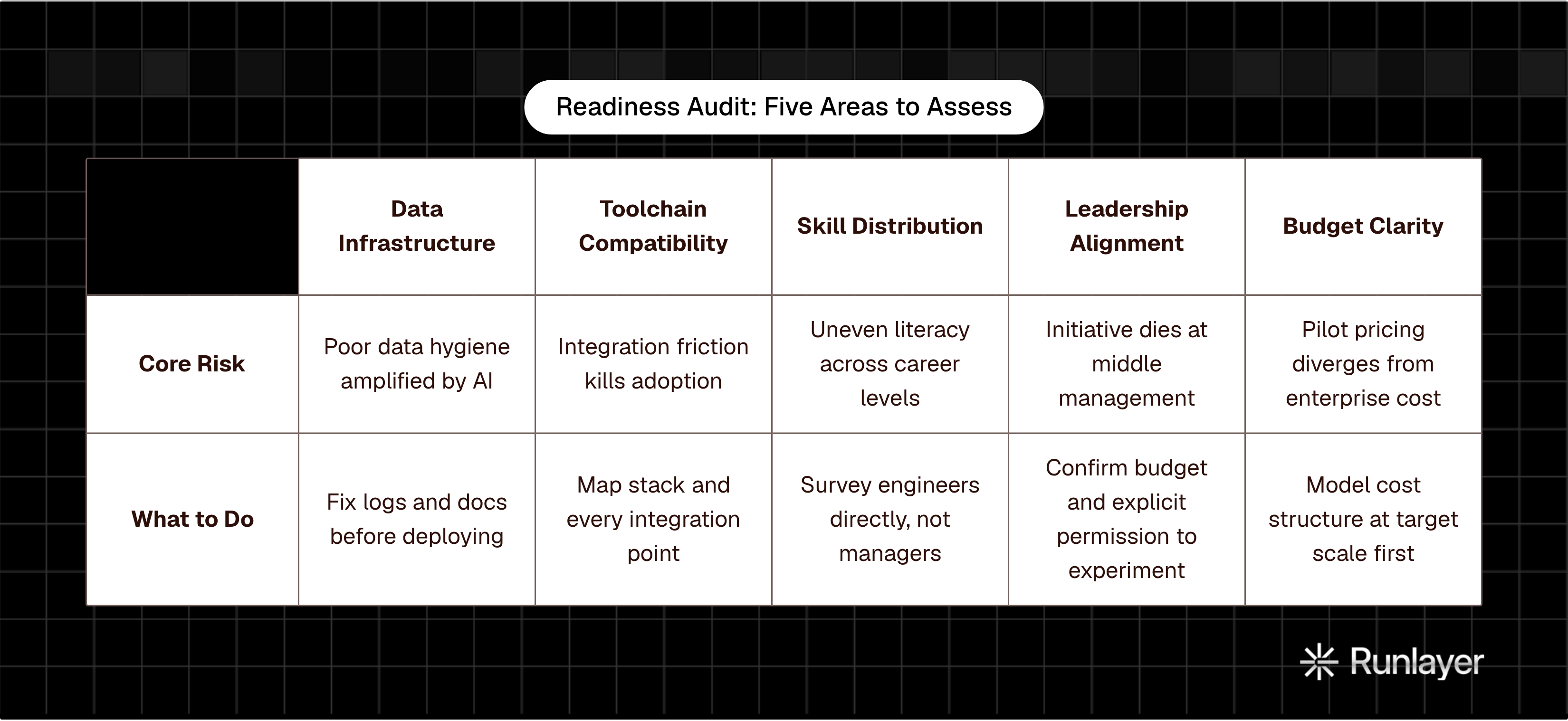
Before any tool selection, run a readiness audit across five areas.
Data infrastructure. AI tools amplify the quality of your existing data, in both directions. Inconsistent logs and outdated documentation become louder problems with AI in the loop, not quieter ones. Fix data hygiene first.
Toolchain compatibility. Map your current stack and treat every integration point as a friction point. Tools that plug into existing CI/CD, IDEs, and observability platforms get adopted. Tools requiring workflow rewrites do not, regardless of what the pilot numbers showed.
Skill distribution. Survey engineers directly, not their managers. Junior engineers need foundational AI literacy. Mid-level engineers need prompt fluency and workflow integration. Senior and staff engineers need to evaluate AI system design tradeoffs and own responsible usage decisions. Four career levels, three distinct training tracks.
Leadership alignment. AI initiatives that lack executive sponsorship die at the middle-management layer. Budget, headcount protection during rollout, and explicit permission to experiment are prerequisites, not nice-to-haves.
Budget clarity. Seat licenses, compute costs, training time, and vendor contract terms compound quickly at scale. Know your ceiling before committing to a vendor, and model cost structure at target scale before signing anything at pilot pricing.
The audit itself is practical work, not a planning exercise. Interview team leads, not just directors. Audit two representative workflows end-to-end. Identify one quick win and one longer-term investment, and treat them as separate workstreams from day one.
Choose Tools With Discipline
Four categories of AI tools matter to engineering organizations: code generation and completion (Copilot, Cursor, and equivalents), testing and QA automation, observability and incident response, and documentation and knowledge management. Each addresses a different drag on engineering throughput.
The build-versus-buy decision comes down to one question: is this a core differentiator? If not, buy. Building LLM infrastructure is expensive, slow, and pulls engineers away from product work that actually moves the business.
When evaluating tools, integration friction is the primary filter. Engineers abandon annoying tools within 60 days regardless of mandate, so a tool's fit with existing workflows matters more than its feature list. After that, security and compliance posture, vendor stability, and cost structure at scale. Pilot pricing routinely diverges from enterprise pricing; model it before signing.
Run a structured pilot before any org-wide commitment. Four to six weeks, one or two use cases, one motivated team, success criteria written before day one. Pilots without pre-defined criteria produce anecdotes, and anecdotes are not decisions.
Standardize on the smallest tool set that covers your use cases. Every additional tool adds cognitive overhead, security surface area, and maintenance burden.
Roll Out in Phases
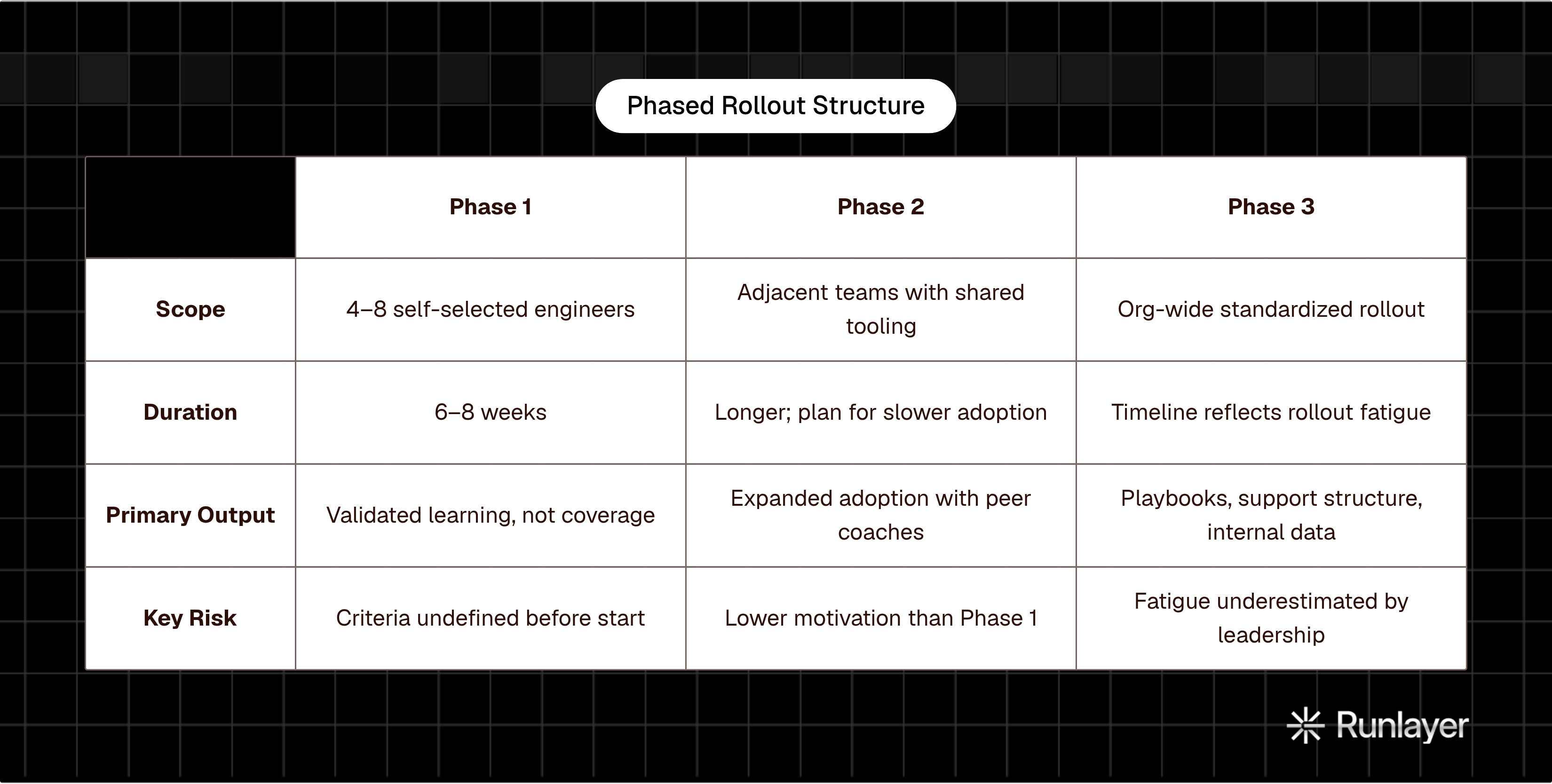
Big-bang deployments compress all organizational learning into a single high-stakes moment. The failure mode is predictable: problems surface at scale, when they are expensive to fix and visible to leadership. Phased rollouts distribute that learning so each phase genuinely informs the next.
Phase 1 is a small, self-selected, motivated team on a single high-value use case. Four to eight engineers, six to eight weeks, one primary metric. The output is validated learning, not coverage.
Phase 2 expands to adjacent teams that share tooling and workflow patterns with the pilot group. Bring Phase 1 participants in as peer coaches. Adoption will be slower here, not because the tool is worse, but because motivation is lower and the social proof that drives early adoption hasn't reached these teams yet. Plan for it explicitly rather than treating it as a failure signal.
Phase 3 is org-wide rollout with standardized practices, documented playbooks, and a real support structure. By this point, you have internal data, internal examples, and trained advocates. You also have rollout fatigue, which is real and underestimated. The timeline for Phase 3 should reflect that.
Write success criteria for each phase before it starts. Communicate the full roadmap to both leadership and engineers. Engineers disengage fast when AI initiatives feel chaotic or performative, and they have seen enough failed tool rollouts to recognize the pattern early.
Build the Skill Layer
Tools without skills produce frustrated engineers and abandoned software. The org that buys Copilot and runs a single lunch-and-learn is the org that reports "low ROI" six months later and blames the vendor.
Run hands-on workshops against real codebases and real problems. Internal hackathons produce more durable learning than curated content, partly because engineers trust problems that are actually theirs. Pair early-adopter senior engineers with mid-level engineers during Phase 1; peer learning is faster and more credible than top-down training.
Self-paced resources and external certifications are supplements for motivated self-starters. They are not primary training vehicles. The primary vehicle is doing real work with the tool and having someone nearby who knows it well.
Build an internal community of practice where engineers share prompts, patterns, and failures. The failures matter especially. Document the outputs as living playbooks, not static wikis that decay within a quarter.
Resistance to AI adoption is usually earned skepticism. Engineers who have lived through failed tool rollouts have good reasons to be cautious. Address resistance with Phase 1 data, not persuasion. Create low-risk environments for experimentation. Reward teams that report honestly on what did not work. Punishing failure during a learning phase kills exactly the feedback loops you need most.
Govern Before You Scale
Governance established after problems arise is incident response. Governance established before scale is infrastructure. The difference is $400k in a breach investigation versus a policy document written during Phase 1.
Write an acceptable use policy before Phase 2. It covers four things: what data engineers are permitted to send to external AI services (no customer PII, no proprietary source code to non-enterprise-tier services, no credentials); rules for AI-generated code in production, specifically review requirements, test coverage expectations, and licensing checks; intellectual property boundaries, which are particularly relevant for code completion tools trained on open-source data; and escalation paths for engineers uncertain whether a use case falls within policy.
Two security risks require explicit attention. Data leakage through prompts and completions is the most common and most underestimated exposure in engineering AI rollouts. AI-generated code introduces supply chain risk because engineers frequently accept suggestions without full review. Establish code review standards that account for both explicitly.
For regulated industries, map AI tool data flows to GDPR, SOC 2, and sector-specific requirements before procurement, not after you have already signed a contract.
Stand up an AI steering committee with representation from engineering, security, legal, and at least one product leader. Meet monthly during rollout, quarterly at steady state. Build audit trails for material AI-assisted decisions.
Measure Outcomes, Not Activity
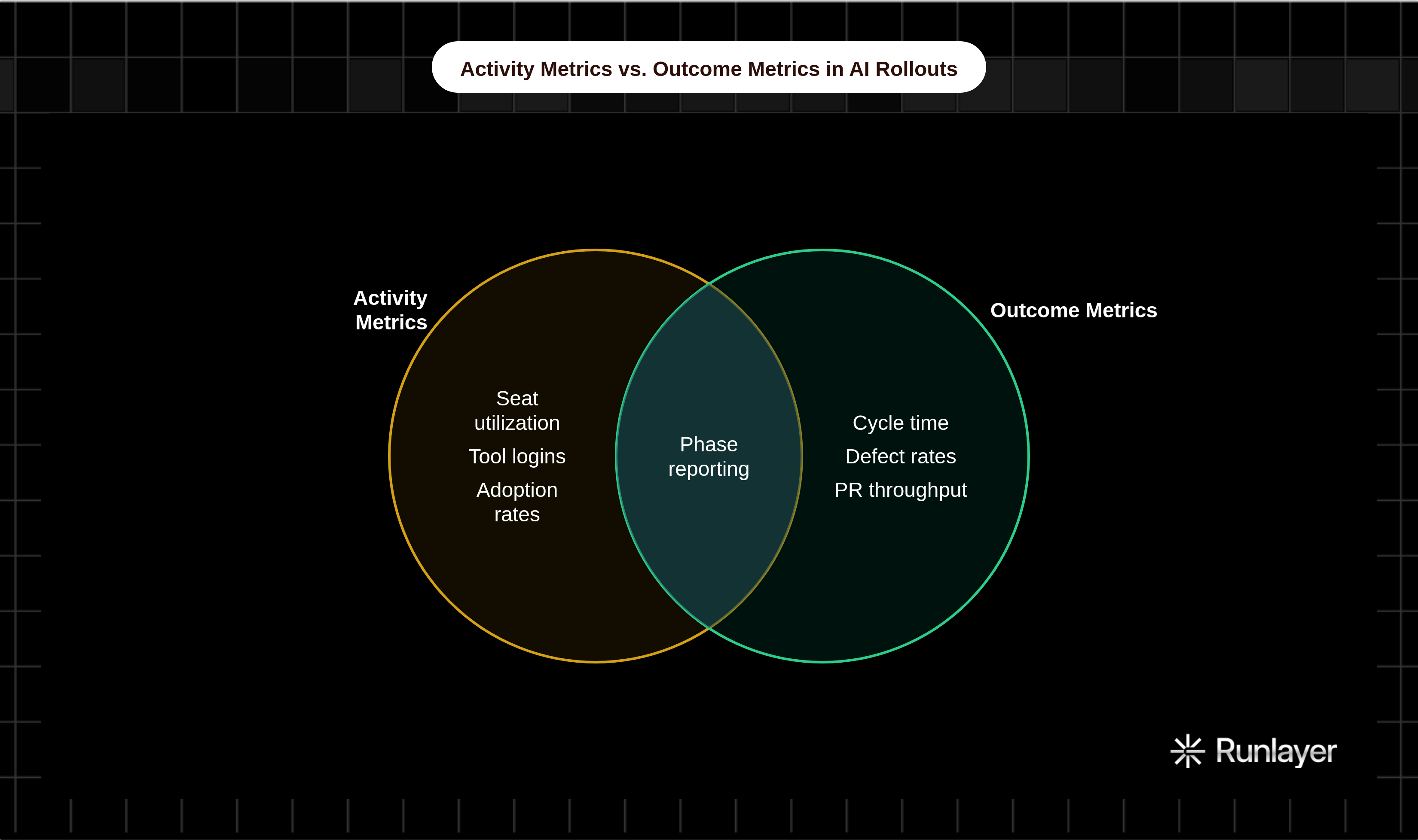
Adoption rates are not outcomes. Usage dashboards are not results. They measure whether engineers opened the tool, not whether the tool moved anything that matters.
Measure cycle time, PR throughput, defect rates post-adoption, and engineer satisfaction through structured surveys. Establish baselines before Phase 1 starts. Without baselines, you cannot attribute change, and without attribution, you cannot make a defensible case for Phase 2 investment.
Run retrospectives at the close of each phase. Report to leadership with data, not narratives. The business case for continued investment is a productivity delta and a defect rate trend, not a room full of enthusiasm.
Tool logins, seat utilization, and AI suggestion acceptance rates are proxies. Engineering outcomes are what you are buying.
Start Now, Scale Deliberately
Assessment, structured tool selection, phased rollout, parallel upskilling, pre-emptive governance, outcome measurement. Run them in that order.
Start Phase 1 this quarter. One team, one use case, one metric, eight weeks. Report the results. Then decide on Phase 2.
The organizations building deliberate adoption infrastructure now will compound that advantage as AI capabilities increase. The ones accumulating tool sprawl and skipping governance will spend the next two years cleaning it up instead of building on it.