AI Agents vs. AI Assistants: What's the Difference?
Agents work autonomously toward goals; assistants only respond to prompts.
AI Agents vs. AI Assistants: What's the Difference?
These are not the same thing, and conflating them puts the wrong tool on the job. The distinction is structural. It determines what you can build, automate, and delegate.
What an AI Assistant Is
An AI assistant is reactive. You prompt it; it responds. Nothing happens between your inputs.
ChatGPT in base form is an assistant. So is Siri, Alexa, Google Assistant. Optimized for dialogue and retrieval. They answer questions, draft text, summarize content, and generate ideas on demand. They do not go looking for problems to solve.
Four structural facts define them. They are stateless between sessions by default: return tomorrow and the system has no memory of you unless you manually reload the context or have enabled a memory feature. They operate within a bounded conversation window with no background process, no continuation after you close the tab. They produce outputs, almost always text, without taking actions in external systems. And they depend entirely on prompt quality. Vague input, vague output. The human steers every exchange.
Low setup overhead, no infrastructure, accessible without technical expertise, and usable without specialized knowledge. Those strengths are real. So is the ceiling. Every step requires a human in the loop. If your bottleneck is access to information, an assistant solves it. If your bottleneck is the human hours required to execute a repeatable process, you are holding the wrong tool.
What an AI Agent Is
An AI agent is autonomous. You give it a goal; it works toward that goal across multiple steps, making decisions, using tools, and adapting based on results without waiting for your next instruction.
The architecture reflects this. Agents combine a large language model with tool use, memory, and a planning loop. The LLM reasons. The tools act, running code, calling APIs, browsing the web, reading and writing files. Memory carries context across steps and sessions. The planning loop breaks a high-level goal into sub-tasks, executes them sequentially, evaluates results, and self-corrects when something breaks. That last capability is the real separator.
AutoGPT is an agent. LangChain agents are agents. OpenAI's Assistants API with function calling enabled sits firmly in this category. A research agent searches, pulls sources, synthesizes, and formats a report without a human directing each step. A software engineering agent writes code, runs tests, identifies failures, revises, and re-tests. A data pipeline agent pulls from an API, cleans, analyzes, and surfaces anomalies on a schedule.
The risks scale with the autonomy. Agents compound errors. A wrong assumption at step one propagates through every subsequent decision, and by the time you notice, the agent has acted on it three times over. Guardrails and oversight checkpoints are not optional additions. They are the difference between a useful agent and an expensive mess that has been confidently wrong since the beginning.
Where the Categories Actually Differ
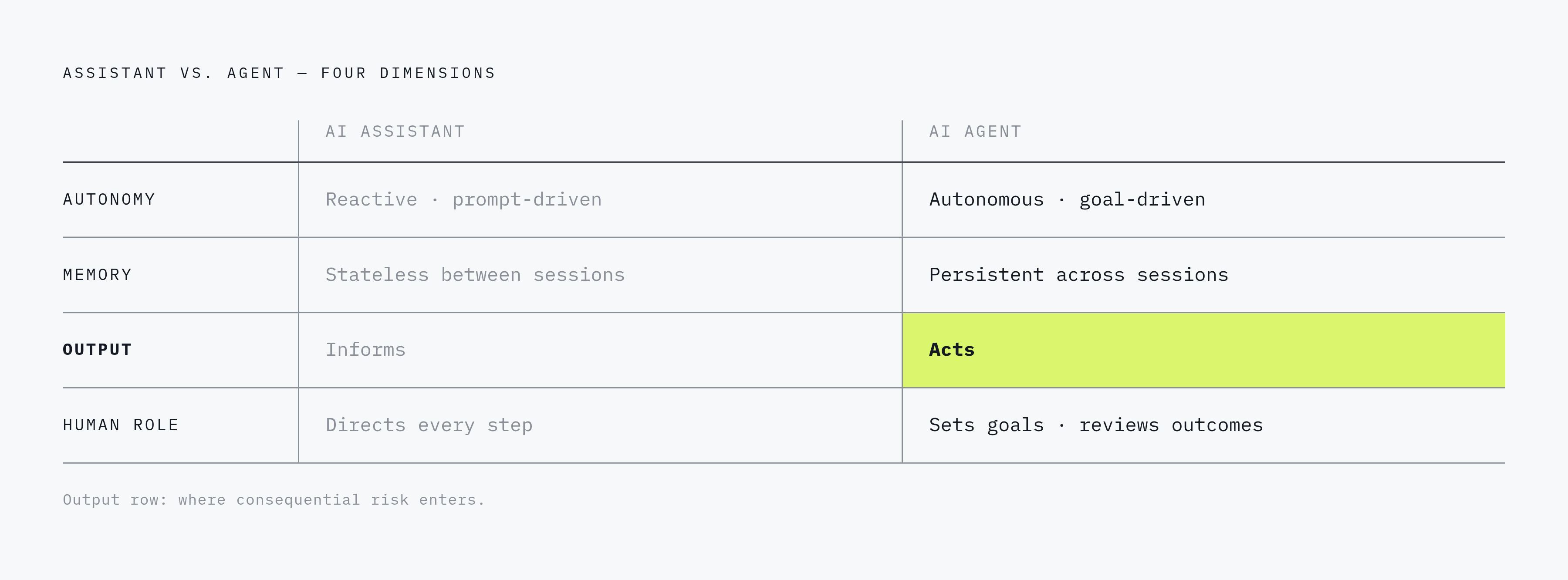
Autonomy is the root distinction. Everything else follows from it.
Assistants generate information. Agents interact with external systems and take actions inside them. An assistant tells you a flight is available. An agent books it. Most of the consequential risk lives in that gap between informing and acting.
Task complexity maps directly onto which tool fits. Assistants handle single-turn and simple multi-turn tasks well. Agents are built for multi-step, long-horizon work where the path from goal to completion involves dozens of intermediate decisions you have no interest in making manually.
Memory is underappreciated. Assistants are stateless. Agents retain memory and state across sessions, which is what allows them to pick up a workflow mid-stream and behave coherently across days or weeks. Statelessness is fine when tasks are self-contained. It becomes a liability when work requires continuity.
Human involvement changes in character, not just quantity. With an assistant, you are the operator. You direct every move, evaluate every output, decide what happens next. With an agent, you are the supervisor. You define the goal, set the boundaries, review outcomes, intervene when something breaks. That shift sounds incremental until you realize it requires you to model failure modes before deployment, not after.
Reliability profiles differ in kind. A bad assistant output is text you read before anything happens. A bad agent output is an action already taken. The assistant's errors surface at the review stage. The agent's errors surface in the aftermath.
Where Each Tool Belongs
Assistants belong in customer support handling FAQs, writing and editing tools, voice interfaces for simple commands, and on-demand document summarization. A human is present and directing each interaction. The output is information rather than action.
Agents belong in automated research workflows, software development pipelines where code gets written and tested iteratively, e-commerce operations with automatic purchase execution, and data pipelines that pull, clean, and analyze on a schedule. The task is too long, too complex, or too repetitive to justify human input at every step.
A growing set of products sit between the two categories. ChatGPT with tools enabled, Microsoft Copilot integrated into enterprise workflows, and Claude with computer use. They look like assistants because you interact with them conversationally. They behave like agents because they take actions in external systems. Understand what the system does, not what the marketing says. Vendors have strong incentives to call everything an agent right now. The word sells.
Picking the Right One
Single exchanges and single outputs belong to assistants. Multi-step workflows spanning multiple tools and sequential decisions require an agent.
Agents match operational reality when teams cannot sustain constant human input across every step. That is not a sophistication argument. It is a resourcing one.
Start with narrow, well-scoped tasks. Expand only after you have observed how the system fails, because it will fail, and those failure patterns show you exactly where guardrails need to go. An assistant serving one person well will not serve a team of fifty. An agent handling ten tasks reliably will behave unpredictably at a hundred.
Choose based on underlying behavior, not brand names. Does it wait for your input or pursue a goal independently? Does it generate information or take actions? Does it forget everything between sessions or maintain state? Those answers tell you what you are actually working with.
What to Do Now
Audit the workflows you want to improve. Information access bottleneck: use an assistant. Human hours bottleneck on a repeatable, multi-step process: use an agent.
Test in low-stakes environments before committing either to production. The cost of getting this wrong is not a bad tool choice. It is a workflow built on wrong assumptions, which takes considerably longer to fix than the original problem took to notice.