How Enterprise AI Permissions Should Actually Work
Enterprise AI inherits human access controls that can't track what autonomous systems actually do.

Enterprise AI Permissions Are Broken by Design
Organizations took access control frameworks built for human users, applied them to autonomous systems capable of reading, reasoning, acting, and sharing data at machine speed, and called it governance. It isn't.
AI systems routinely inherit the maximum permissions of their integrators. Binary allow/deny models cannot express the difference between an AI that reads a document and one that exfiltrates it. Access granted at deployment is almost never revisited. Shadow AI deployments multiply ungoverned permission sprawl across business units. This is the current state of most enterprise AI infrastructure, not a projected risk.
The consequences are specific. Data exfiltration surfaces expand without visibility. GDPR, HIPAA, SOC 2, and CCPA obligations break silently. Insider threat potential multiplies because AI systems act on behalf of users with none of the behavioral friction that catches human bad actors. Audit failures follow because the logs were never designed to capture what AI systems actually do.
Why Role-Based Access Control Doesn't Transfer
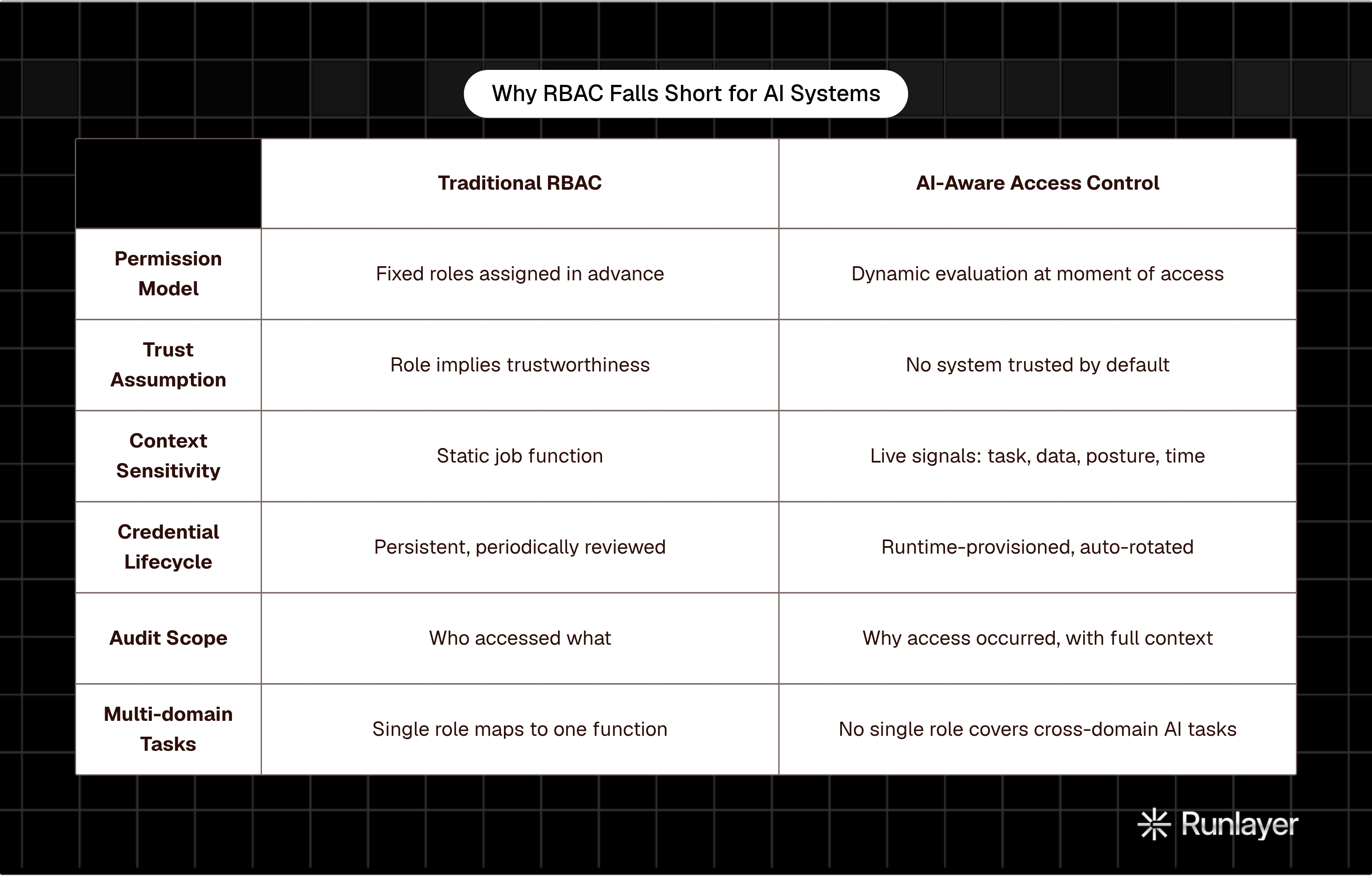
RBAC was designed for human workers with stable job functions. Assign a role, attach permissions, audit periodically. It works because human workflows are relatively predictable and static.
A single AI task can simultaneously require access to HR records, financial data, customer communications, and external APIs. That pattern matches no single human role. Most organizations respond with role explosion: custom permission bundles for each AI use case, which compounds the management problem without solving the governance one. An AI assistant that begins a session helping with internal reporting and pivots to drafting customer-facing communications faces a different risk profile than when it started. RBAC has no mechanism to track that shift. I've seen this exact failure pattern in organizations that considered themselves mature on access governance, and the surprise is always the same.
Context-Aware Access Control evaluates permissions dynamically against live signals: user identity, device posture, data sensitivity, task type, time of access, location. Permissions are not granted in advance and left open; they are evaluated at the moment of access against current conditions. This integrates naturally with zero-trust architecture, where no system is trusted by default.
The practical implementation is hybrid. RBAC sets the baseline floor; no AI system receives more access than its role classification permits by default. Contextual controls layer on top, enabling temporary elevation for specific high-sensitivity tasks and tightening restrictions when signals indicate elevated risk. Policy-as-code encodes access rules in version-controlled, auditable logic rather than manual configuration spread across disparate systems.
Least Privilege Is an Engineering Workflow, Not a Setting
Start from zero permissions. Grant access incrementally based on documented need.
Before any access is assigned, map the AI workflow completely. Identify every data source the system touches. Classify sensitivity. Document expected actions and outputs. This exercise consistently reveals that AI systems request access to data they don't need, because access was estimated broadly at procurement rather than scoped precisely at design. The gap is rarely small.
Scoped API tokens and service accounts go to each AI task, not to the AI system as a whole. Each discrete function gets its own credential set, limited to what that function requires. AI systems hold no persistent credentials. Secrets management infrastructure provides credentials at runtime and rotates them automatically. Just-in-time provisioning handles elevated operations: access opens for a specific action, for a specific duration, and closes automatically.
Sandboxed environments for AI experimentation prevent prototype-stage access patterns from bleeding into production governance. Permission reviews tie to model updates and use case changes, not to calendar schedules.
Third-party AI tools require identical discipline. Require documented permission scopes before procurement. Build contractual data handling obligations into vendor agreements. An AI vendor that cannot specify exactly what data their system accesses and why fails enterprise governance standards regardless of product capability.
Auditability
AI systems demand stronger auditability than traditional software for two reasons. Their behavior is non-deterministic, making prediction impossible and traceability essential. Their actions cascade across connected systems fast, meaning a single access event triggers downstream consequences that are difficult to reconstruct without complete logs.
Every data access event needs a timestamp and full context. Permission grants, denials, escalations, and human overrides. Model inputs and outputs where permissible under applicable data regulations. These logs require tamper-evident storage and retention aligned to regulatory requirements. Logs that can be altered are not audit logs; they are liability.
Explainability extends to permissions themselves. AI systems should surface why they accessed specific data, not just record that they did. This supports compliance investigations with traceable justification chains and makes AI behavior legible to non-technical stakeholders who otherwise have no basis for trusting what they can't see.
Real-time monitoring on anomalous access patterns catches permission abuse before it becomes a breach. Regular attestation requires AI system owners to actively confirm that current permissions still match current use cases. Automated monitoring and human attestation together close the gap that purely automated systems leave open.
Where Organizations Are Failing Right Now
Granting admin-level access to AI agents to avoid friction at deployment is the single most common governance failure in enterprise AI. The convenience is immediate; the compounding risk runs for the entire system lifecycle. It's the kind of shortcut that feels like pragmatism at the time and reads as negligence in a post-breach audit.
Treating AI permissions as a one-time configuration ignores that AI systems evolve. Model updates change capability boundaries. Use cases expand. New data sources get connected. Each change is a permission event that requires review.
Scrutinizing customer-facing AI while ignoring internal-facing tools inverts the actual risk profile. Internal AI systems access employee data, financial records, proprietary processes, and strategic communications, frequently without the compliance scrutiny applied to consumer products.
Conflating user consent with enterprise data governance is both a legal and operational error. A user granting an AI tool access to their inbox is not the enterprise authorizing that tool to ingest and train on corporate communications. That distinction carries regulatory weight.
Permission vectors for AI training data are consistently underestimated. Data ingested during training is data the model will surface later, in contexts and to users for whom access was never intended. Training data ingestion requires the same permission controls applied to operational access.
Prompt injection is an active attack surface. Malicious instructions embedded in external data redirect AI behavior in ways that bypass permission controls entirely. Permission architecture accounts for this vector explicitly, or it doesn't account for it at all.
Siloed ownership across security, IT, and AI teams produces permission structures that satisfy no team's requirements completely. One team owns the policy; one team owns the implementation; one team owns the AI system. Governance fails in the gaps between them, not at the center.
What to Do With This
Audit your current AI permission posture against these principles. Map what your AI systems access against what they actually need to access. The gap between those two lists is your current exposure, and in most organizations that gap is wider than anyone on the leadership team knows.
Least privilege as the default, task-scoped credentials, time-bound access tied to declared intent, human approval for high-risk actions, immutable logs with real-time monitoring, and contextual controls layered over a role-based baseline. That is the full framework. None of it is exotic.
Organizations that build this correctly get an auditable, defensible foundation for scaling AI. Organizations that don't face regulatory exposure, breach risk, and audit failures that compound as AI deployment accelerates. Governance infrastructure has to evolve with the technology, because the technology will not wait for the governance.