How the Best AI-Native Companies Empower Employees Without Losing Control
Leading AI companies build role-based access and embed accountability in culture, not just policy.

The Balance Is the Strategy
AI-native companies that win the next decade will not be the ones with the most powerful models. They will be the ones that figured out how to put AI in employees' hands without watching the organization unravel. Access with accountability is not a cultural afterthought. It is the core operating challenge of building on AI right now.
What AI-Native Means
AI-native describes an architectural choice, not an aspiration. AI is designed into core workflows from the start, not bolted onto legacy processes after someone reads a McKinsey report.
In a genuinely AI-native organization, data infrastructure is built for AI consumption. Employees work alongside AI tools daily. Product and operations are co-designed with AI. Decision-making at every layer treats AI outputs as standard inputs, not optional supplements.
The distinction matters for one reason: when AI is peripheral, a governance failure is contained. When AI runs through everything, a governance failure scales at exactly the same speed as the business itself.
The Empowerment-Control Problem
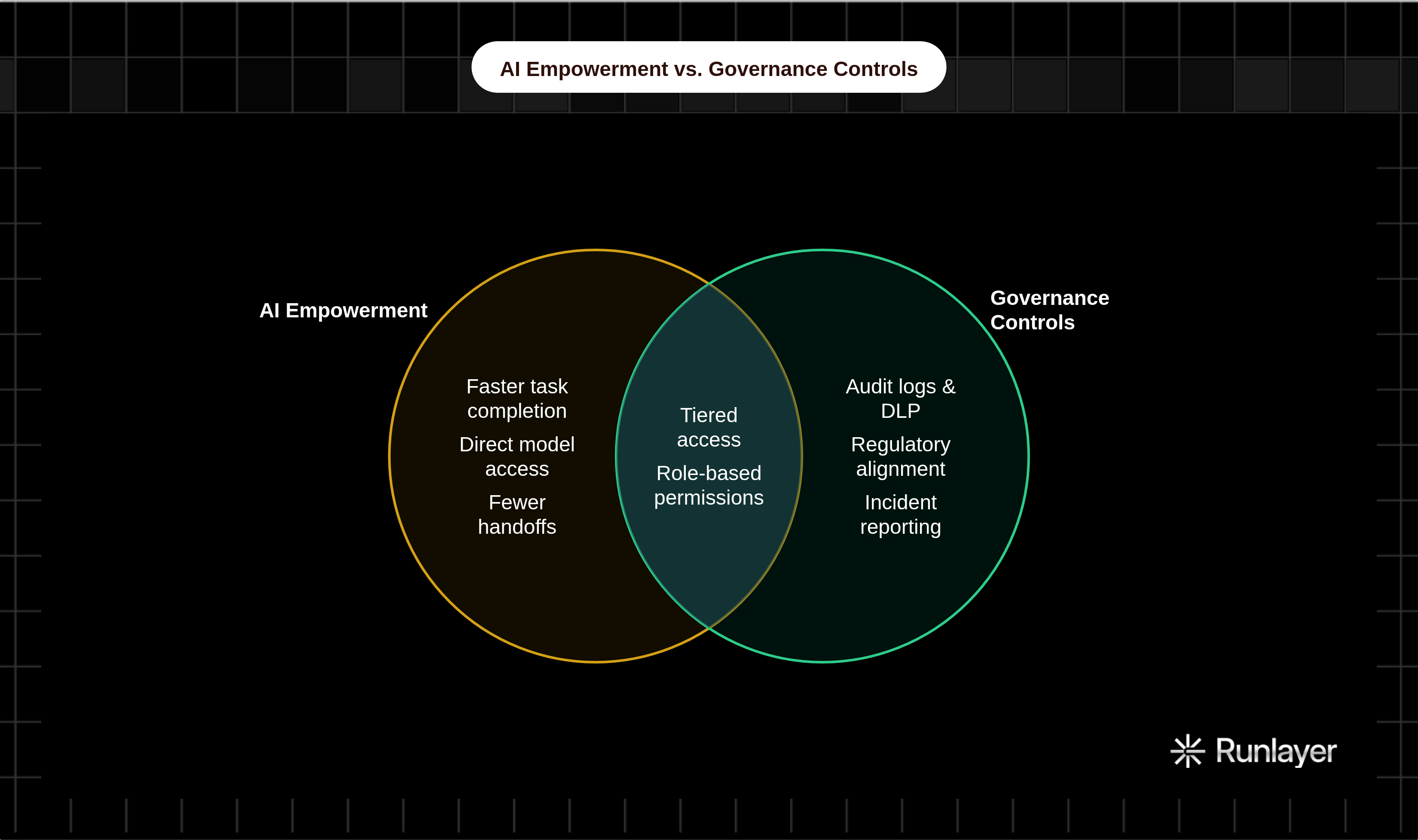
The gains from broad access are real. McKinsey found AI-enabled knowledge workers complete complex tasks 25-40% faster with measurable quality improvements. Direct access to capable models, autonomy to build and automate, faster decisions without traditional approval bottlenecks, and fewer handoffs between human and machine. These are not theoretical benefits.
The failure modes are equally concrete. Employees paste customer data into public LLM interfaces. Brand voice fractures when 200 people prompt their way to 200 different outputs. Shadow AI. Employees defaulting to unsanctioned tools because approved ones are too locked down creates the exact security exposure governance was designed to prevent. Automated decisions carry bias at scale. Regulatory exposure accumulates silently until an audit surfaces it.
The reflex is to tighten control. It backfires every time. A policy written for one model version is functionally stale within months. Over-restriction accelerates underground adoption. This is not a dial you calibrate by finding the midpoint. It requires a different architecture entirely.
How the Leading Companies Do It
Blanket bans fail. Tiered access works. Role-based permissions mean a data scientist, a customer service rep, an HR partner, and a product manager each have different tool access calibrated to their actual use cases and the data they legitimately touch. Approved tool ecosystems replace the binary of everything-or-nothing and give employees real choices inside a vetted perimeter.
Process-level controls get circumvented. What does not get circumvented is judgment baked into the person making the decision. When employees genuinely understand how to evaluate AI outputs critically, recognizing hallucinations, spotting bias, knowing when to escalate, and understanding liability, governance becomes self-reinforcing rather than adversarial. The goal is employees who ask "should I trust this output?" before acting, not because a checklist forces it, but because they understand what is at stake.
Policies written in Q1 for a specific model version are stale by Q3. The companies getting this right build explicit review cycles tied to model updates and new use cases. They run employee feedback loops into policy revision because end users surface edge cases that legal and compliance teams never see from a conference room.
Serious AI-native companies do not start with broad rollouts. They run pilots, track behavior, and expand permissions based on demonstrated responsibility. This generates the data needed to refine governance and signals to employees that the company takes both capability and risk seriously, rather than performing concern while just hoping for the best.
Governance Frameworks That Get Used
Most governance frameworks fail because legal and compliance teams write them without input from anyone who uses the tools. The result is a document that exists for regulatory defense. No engineer reads it twice.
Effective frameworks are operational. Specific dos and don'ts, not principles. Defined data classification rules that tell employees exactly which data categories can enter which tools. Human-in-the-loop requirements for high-stakes decisions, covering hiring, lending, medical, and legal contexts. Incident reporting protocols designed to make surfacing AI failures easy rather than career-threatening.
Governance that lives only in the legal department gets ignored by engineering. Cross-functional structure with real representation across legal, engineering, HR, and business units is what makes the framework legible to the people operating inside it. Without that, you have a document, not a system.
Technology controls close the loop. Audit logs create visibility. Approved vendor lists eliminate the most common attack surfaces. Data loss prevention integrations catch sensitive data exfiltration before it becomes a breach rather than after.
On regulatory alignment: GDPR, the EU AI Act, CCPA, and HIPAA. Map your framework directly to specific requirements. General coverage is not coverage. It is a liability dressed up as compliance.
Culture Is the Control Mechanism Policy Cannot Be
Policy is the floor. Policies get circumvented. Culture shapes instincts, and instincts operate at the speed of real work.
Executives who visibly model responsible AI use set the behavioral norm faster than any training program. When a CEO publicly corrects an AI-generated output or acknowledges an AI-related mistake, it gives everyone else permission to do the same. That is not symbolism. It is the fastest available mechanism for normalizing the behavior you need at scale.
Training programs that work are role-specific and scenario-based. Generic AI literacy modules do not transfer to practice. Training built around the actual decisions employees face, with ethics and risk scenarios embedded in onboarding, produces employees who handle novel situations competently. The generic version produces employees who passed a module.
Psychological safety around AI mistakes is a risk management tool, not a soft culture initiative. Organizations where employees hide AI failures accumulate unreported incidents. Organizations where reporting is normalized get early warning before risks scale. The difference between those two outcomes is not policy language. It is whether people believe surfacing a problem will cost them.
Recognition matters here in a specific way. If the only behavior you reward is speed, speed without care is what you get. Reward the employee who flagged a bias problem, the one who surfaced a data handling issue before it scaled, the one who caught a compliance gap. That reinforcing cycle is what makes governance sustainable rather than performative.
Measuring Whether the Balance Is Real
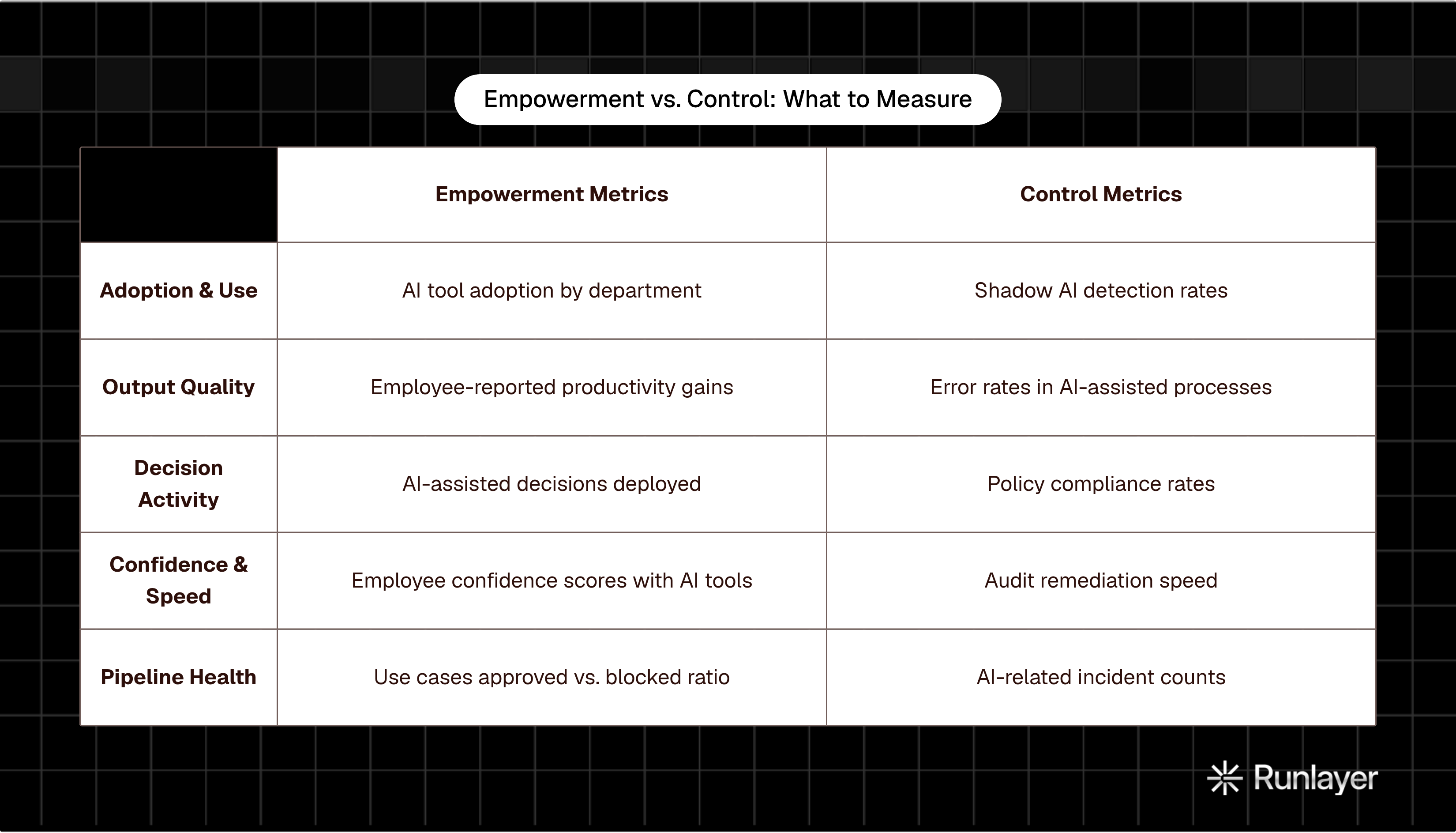
Without measurement, balance is a claim.
Empowerment metrics to track include AI tool adoption by department, employee-reported productivity gains, AI-assisted decisions deployed, and employee confidence scores with AI tools. Control metrics include policy compliance rates, AI-related incident counts, shadow AI detection rates, and audit remediation speed.
The numbers that reveal the most are the ratio of AI use cases approved versus blocked and time from AI idea to sanctioned deployment. High blocked ratios and slow deployment times mean the governance model is suppressing value. Climbing incident rates alongside rising adoption mean controls are not keeping pace with the business. Both failure modes are visible in the data if you are collecting it.
Business outcomes close the loop. Revenue impact of AI-driven initiatives, cost reduction from automation, error rates in AI-assisted versus manual processes, and customer outcomes tied to AI-enabled decisions. If governance is calibrated correctly, these numbers improve together. If they diverge, something in the balance is broken.
The Competitive Implication
The companies that master this build a structural advantage that compounds. Employees who trust the tools, understand the risks, and operate inside a framework that enables rather than restricts move faster and make better decisions than employees working around broken governance or locked out entirely. That gap widens every quarter.
Audit your current posture. Map where employees have access, where they are working around restrictions, and where governance is theoretical rather than operational. The gap between where you are and where the leading AI-native companies operate is closeable. The longer it stays open, the more it costs.