Prompt Injection Explained for Engineering Teams
Attackers can hijack LLM behavior through hidden instructions in user input and external data.

Intro
Hook: LLMs are increasingly embedded in production systems
Brief framing of the security risk landscape for AI-powered apps
Why prompt injection is now a top concern for engineering teams
What the post will cover and who it is for
What Is Prompt Injection
Plain-language definition of prompt injection
Analogy to classic injection attacks (SQL injection, XSS)
How LLMs process instructions and why they are inherently vulnerable
The trust boundary problem
System prompt vs. user input vs. external data
Why LLMs cannot reliably distinguish trusted from untrusted content
Key terminology: system prompt, user prompt, context window, instructions
Types of Prompt Injection Attacks
Direct prompt injection
User directly overrides or manipulates system instructions
Common patterns: "ignore previous instructions," role-play jailbreaks
Indirect prompt injection
Malicious instructions embedded in external data the LLM reads
Sources: web pages, documents, emails, database records
Stored prompt injection
Payload persisted in a datastore and triggered later
Similarities to stored XSS
Multi-turn and chained injection
Spreading attack across multiple conversation turns
Chaining LLM agents to propagate injected instructions
Prompt leakage / extraction attacks
Goal of extracting hidden system prompts or confidential context
Real-World Examples
Bing Chat / Sydney manipulation incidents
Indirect injection via malicious web pages in browsing-enabled assistants
Plugin and tool-call hijacking in agentic systems
Email assistant attacks: auto-forwarding sensitive data via injected instructions
Document-based attacks in RAG pipelines
Lessons and takeaways from each example
Why Engineering Teams Should Care
Business and security impact
Data exfiltration and privacy violations
Unauthorized actions taken on behalf of users or systems
Reputational damage and compliance risk
Expanding attack surface as LLMs gain more capabilities
Tool use, code execution, external API calls
Multi-agent orchestration pipelines
Responsibility falls on builders, not just model providers
Regulatory and liability considerations (GDPR, emerging AI regulations)
Difficulty of patching: no simple software update fixes the problem
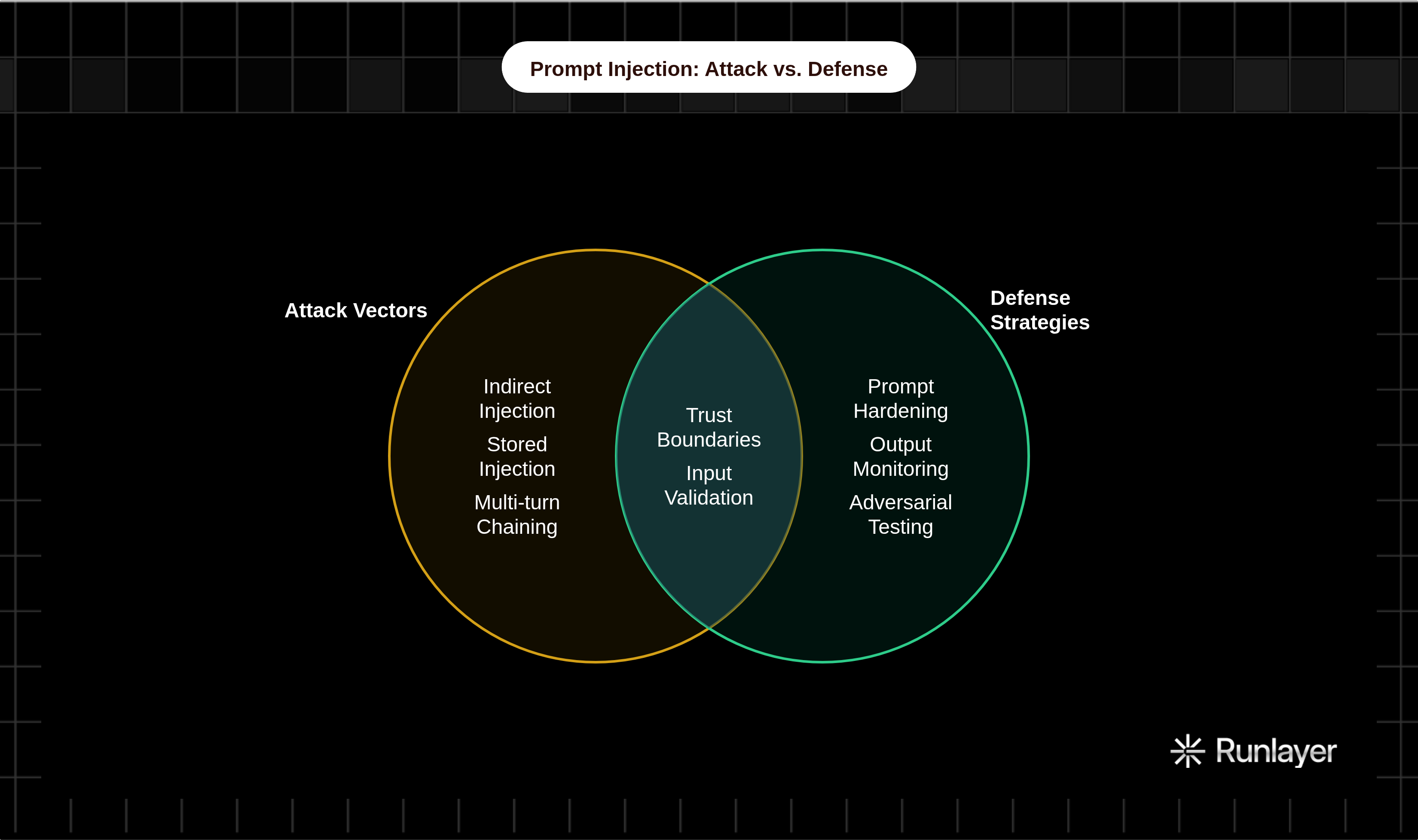
Detection and Prevention Strategies
Input validation and sanitization
Filtering known malicious patterns
Limitations of purely rule-based approaches
Prompt hardening techniques
Clear delimiters between system instructions and user content
Explicit instruction reinforcement and repetition
Privilege separation and least-privilege design
Limiting what the LLM can access or execute
Scoping tool permissions tightly
Output monitoring and anomaly detection
Logging and auditing LLM inputs and outputs
Secondary model or classifier to flag suspicious responses
Human-in-the-loop confirmation for high-risk actions
Adversarial testing and red-teaming
Building injection test suites
Using automated tools and manual testing
Keeping up with evolving research and community disclosures
Building Safer LLM Applications
Threat modeling LLM features before shipping
Identifying trust boundaries in the system design
Mapping data flows that touch the context window
Defense-in-depth architecture
Not relying solely on prompt-level defenses
Application-layer guardrails independent of the model
Secure RAG pipeline design
Sanitizing retrieved content before injection into prompts
Source attribution and trust scoring
Safe agentic design patterns
Confirmation steps before irreversible actions
Scoped agent roles and sandboxed execution
Developer education and security culture
Including prompt injection in security training
Establishing internal guidelines for LLM feature development
Useful frameworks, tools, and resources
OWASP LLM Top 10
Relevant open-source scanning and testing tools
Conclusion
Recap of why prompt injection is a serious and unique threat
Key mindset shift: treat LLM inputs as untrusted attack surfaces
Summary of the layered defense approach
Call to action: start threat modeling, red-teaming, and applying defenses now
Forward-looking note: the field is evolving and vigilance is ongoing