The Biggest Mistakes Companies Make When Deploying AI Agents
Companies skip strategy, data validation, and oversight before deployment, guaranteeing failure.

The Biggest Mistakes Companies Make When Deploying AI Agents
AI agent deployments are failing at scale, and the failures are predictable. Organizations racing to automate are burning budget, damaging customer relationships, and exposing themselves to regulatory liability. Not because the technology doesn't work, but because they skip the fundamentals.
What Makes Agents Different From Everything Else You've Deployed
An AI agent perceives inputs, reasons about them, and takes actions across multiple steps and external systems, autonomously or semi-autonomously. Agents call APIs, execute workflows, query databases, and make decisions within defined or open-ended parameters. They are not chatbots. They are not static models that return a prediction and stop.
That distinction changes the entire risk calculus. A wrong prediction from a classifier sits in a report. A wrong decision from an agent sends emails, moves money, or files a support escalation before anyone reviews it. Teams that don't internalize this before they build learn it the hard way after, usually at the worst possible moment: a production failure on a Friday, a customer complaint that's already been screenshot, a regulatory inquiry that starts with "walk us through the agent's decision log."
There is no decision log, of course. There never is.
The Strategy Phase Nobody Does
Most failed deployments start here, before a single line of code. Teams pick a use case because a competitor announced something similar, or because a vendor demo looked impressive in a conference room with no production load, and move straight to implementation.
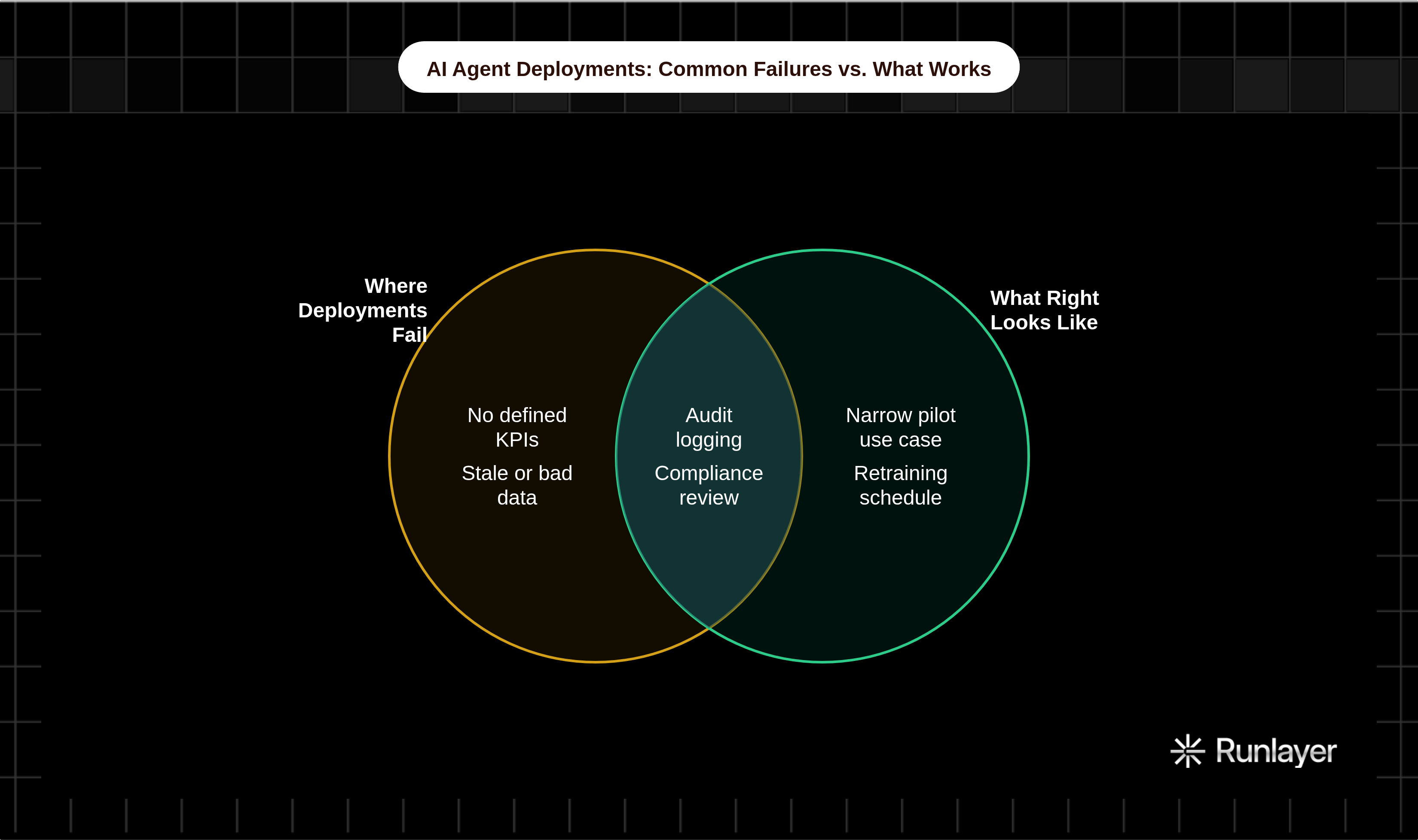
The symptoms are consistent: no defined KPIs, no clear owner for the agent's outcomes, and business and engineering teams operating on different assumptions about what success looks like. Agents get deployed against mandates like "improve efficiency," which is useless when you're debugging a production incident at 2 a.m. three months later and trying to explain to a VP what the agent was actually optimizing for.
A poorly scoped project doesn't just waste the initial build cost. It creates technical debt, misaligned teams, and agents drifting toward proxy metrics that have no relationship to business value. The agent hits its target. The business gets worse. Nobody can explain why.
The fix is boring and almost nobody does it: identify a bounded, high-value problem first; define the measurable outcome before writing code; get engineering and product aligned on what the agent is optimizing for; make the build-vs-buy decision based on that scope rather than on what's available off the shelf this quarter. Clarity at this stage is the single highest-leverage investment in the entire deployment.
Data Quality Is the Constraint, Not the Caveat
Agents perform exactly as well as the data they operate on. This governs everything else.
The recurring failures are predictable in retrospect and invisible in the moment: feeding agents stale or incomplete datasets, tolerating inconsistent formats across integrated systems, assuming a pre-trained model's general knowledge substitutes for domain-specific tuning, and relying on a single data source when redundancy would catch corruption early. A customer support agent trained on generic corpora will mishandle industry-specific terminology, escalation logic, and product edge cases with complete confidence. It won't hesitate. It won't flag uncertainty. It will just be wrong, at scale, until someone notices.
Poor data quality doesn't produce polite errors. It produces confident wrong decisions, hallucinations amplified across automated workflows, and compounding downstream errors that are expensive to trace back to their source. One data integrity failure at input corrupts every action the agent takes downstream.
Audit data pipelines before deployment. Build validation checkpoints into every integration. Monitor data inputs continuously after launch, because model drift from degrading data is a post-deployment risk, not a pre-deployment one you solve once and forget.
The Oversight Problem Nobody Wants to Talk About
Teams cut human-in-the-loop design under pressure to reduce headcount or because agents performed well in controlled testing. Testing environments do not reproduce the edge cases, adversarial inputs, and contextual complexity of production. That gap between test accuracy and production reality is the most common reason oversight gets quietly deprioritized, usually by someone who will no longer be on the project when the consequences arrive.
What follows is high-stakes decisions in financial, medical, legal, and operational contexts executing without review. Errors propagating at machine speed. Customer harm accumulating over days before a human sees it. And when something goes wrong, nobody can answer the question that matters most: who is actually responsible for this agent's decisions?
Tiered autonomy is the architecture that works. Agents operate autonomously within defined confidence thresholds and escalate outside those bounds to a human reviewer. This requires audit logs that capture agent reasoning at each step, regular human review of edge cases, explicit ownership structures for outcomes, and a clear escalation path when the agent surfaces a decision it cannot justify. Building this after deployment is an order of magnitude harder than building it before.
Security and Compliance Are Architecture Decisions, Not Checklist Items
Agents expand the attack surface in ways most security reviews miss. They hold credentials, call external systems, process sensitive inputs, and take actions that are difficult to reverse. Treating them like a standard SaaS integration is where the exposure begins.
The specific failures are recurring. Agents get granted excessive permissions beyond what their function requires because scoping access takes time and nobody wants to slow down the launch. Input validation gets skipped under the assumption that agent inputs come from trusted sources. Prompt injection vulnerabilities get overlooked entirely because the team's threat model was written for a different class of system. Third-party tool integrations get added to agent workflows without security vetting because the vendor seemed reputable.
On compliance, agents routinely handle PII without adequate controls. Healthcare and financial deployments create exposure when audit trails are incomplete. Agent-generated decisions create liability questions that legal teams need to answer before deployment, not after the first incident surfaces them in the worst possible framing.
Apply least-privilege to every permission the agent holds. Include security review as a deployment gate, not a post-launch task. Involve compliance before the architecture is finalized. The threat landscape shifts, and agent behavior evolves with retraining, so ongoing vulnerability assessment is standard maintenance, not optional overhead.
What Right Actually Looks Like
Pilot with one narrow, well-defined use case and measure rigorously before expanding scope. Expansion is a decision made from data, not from confidence in how the demo went or how clean the test environment looked.
Build cross-functional teams before deployment begins. Engineering, product, legal, compliance, and operations need alignment at the architecture stage. Retrofitting legal or compliance review after the fact is expensive and frequently requires rebuilding from scratch. Data quality and security architecture get investment before agent capability does. Human oversight workflows are specified before the agent goes live.
Define success metrics at the outset and monitor against them continuously. Feedback loops from users and downstream stakeholders surface problems that dashboards alone don't catch. Schedule regular retraining and model updates. A model that performed well at launch degrades without maintenance, and it degrades quietly, in ways that compound before they become visible.
Document agent behavior specifications, decision boundaries, escalation rules, and incident response plans. Documentation forces clarity during design and creates the audit trail that regulatory review requires later. Organizations that skip it are not moving faster. They are borrowing time at a rate they don't know yet.
Where the Competitive Gap Actually Lives
The organizations capturing real advantage from AI agents are not running more sophisticated models. They're running tighter processes, building better data foundations, and treating oversight as a feature rather than friction. The organizations failing are not failing because the technology let them down. They made a series of decisions that were each individually defensible and collectively disqualifying.
The gap closes with process discipline, not model upgrades. Assess your current or planned deployment against the failures above. Where the answer is uncertain, treat it as a gap and close it before building further. The organizations that do this build a compounding advantage. The ones that don't spend the next 18 months cleaning up what they rushed to ship, and explaining to stakeholders why the thing that was supposed to save time is now consuming it.