The Future of Enterprise Software Is AI-Native
Organizations that confuse AI add-ons with architectural redesign will fall a generation behind.

The Future of Enterprise Software Is AI-Native
Enterprise software is undergoing its most significant architectural shift in 30 years. The cloud migration from on-premise ERP redefined how businesses operate. AI-native software will do the same, faster, with wider consequences, and without the luxury of a long adoption runway.
This is not about adding AI features to existing tools. A new software category is forming, and the organizations that misread it as a feature upgrade rather than an architectural replacement are already behind. The gap between those who understand the distinction and those who don't will widen faster than the cloud gap did, because the underlying technology improves with usage. Waiting and watching is itself a compounding position.
What AI-Native Means
AI-native software is architected from the ground up with AI as the core operating layer. Not bolted on, not layered over an existing schema. The foundation of logic, workflow, and user interaction is AI.
Traditional software runs on a fixed model where humans define rules and software executes them. AI-native software reasons, learns, adapts, and improves. The system makes or recommends decisions in real time, improves continuously from usage, and accepts natural language as its primary interface rather than treating it as a novelty feature.
This is a design philosophy, not a feature checklist. A product built on rule-based architecture with a chatbot surfaced on top is not AI-native. The AI is decorative. The business impact is proportionally limited. The distinction sounds academic until you're looking at two competing bids, one from a vendor running AI-native decisioning and one from a legacy platform with a Copilot integration, and trying to explain to your board why the two are operationally equivalent. They are not.
AI-Native vs. AI-Enabled
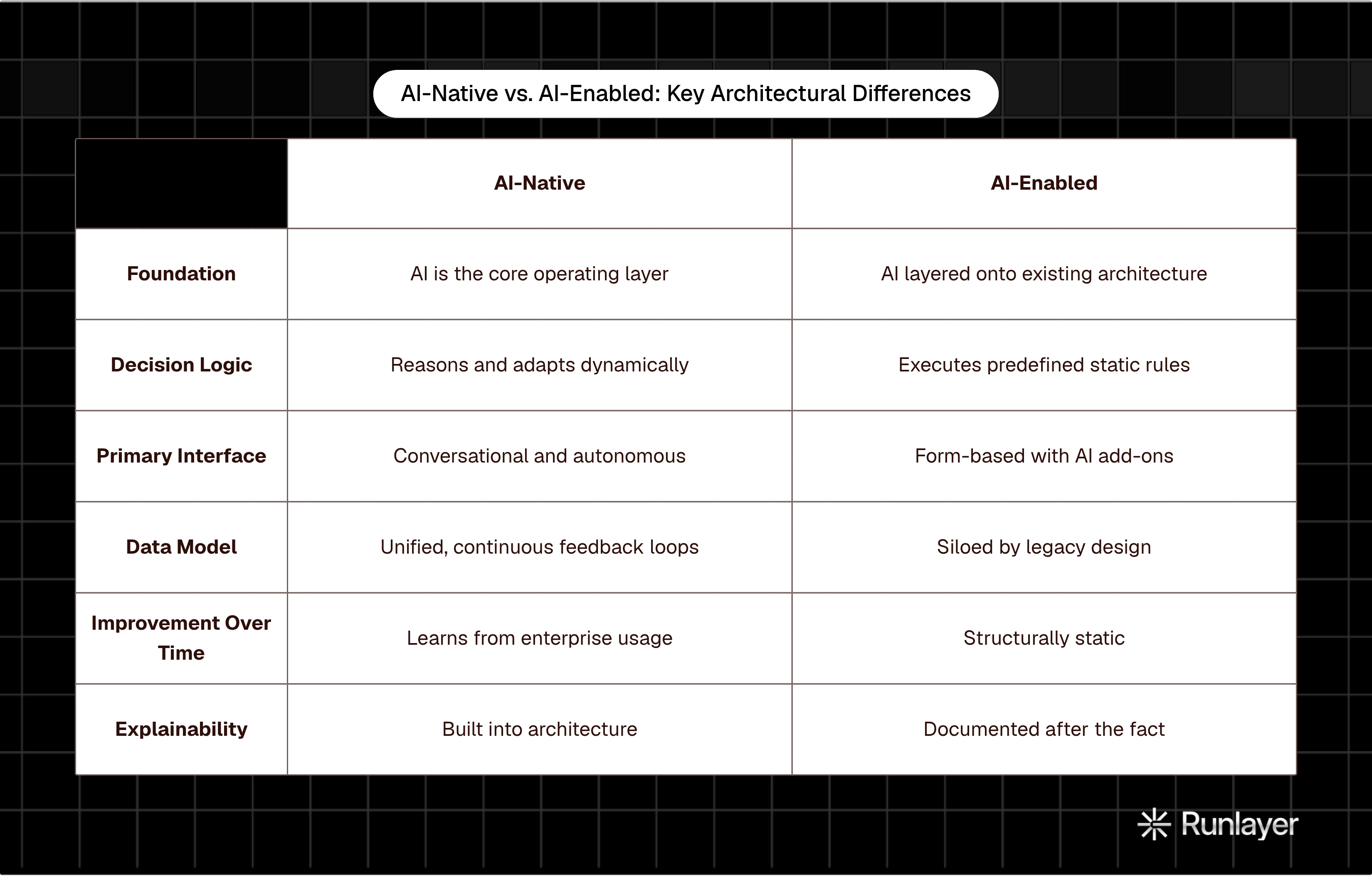
The difference between AI-native and AI-enabled software is architectural, and it matters more than most enterprises have stopped to consider carefully.
AI-enabled software takes legacy or SaaS architecture and layers AI capabilities on top. A chatbot grafted onto Salesforce. Predictive analytics plugged into SAP. Microsoft Copilot added to Microsoft 365. The core architecture stays intact. The AI is a passenger, constrained by a data model and workflow logic that predates it.
AI-native software builds AI into the data model, UX, automation logic, and business rules from the start. The architecture is the differentiator, not the feature set. AI-native systems don't apply static rules; they learn dynamically from usage. The interface is not form-fill; it is conversational and increasingly autonomous. Data structures are not siloed by design; continuous feedback loops run across unified data.
Organizations that invest in AI-enabled tooling while believing they are making a genuine AI-native transition will find themselves a full architectural generation behind competitors who built correctly. Two years is not a long runway to recover that position. The gap does not close by adding more AI-enabled integrations; it closes by rebuilding the foundation, which takes longer and costs more the later it starts.
What AI-Native Architecture Requires
Reasoning and agentic capability are structural requirements. The system acts rather than assists. It completes multi-step tasks without requiring human hand-holding at each step. Glean built its enterprise search platform so the AI reasons across connected data sources rather than returning keyword matches ranked by proximity. That is not a UI difference; it is a fundamentally different product behavior enabled by architecture. You cannot retrofit reasoning onto a keyword-match engine by updating the front end.
Natural language as the primary interface reduces end-user training burden because the interface meets users at the level of how they already communicate. That productivity gain is real and measurable in deployment timelines and adoption rates, not in user satisfaction surveys.
Continuous learning on enterprise-specific data is what separates a useful system from a generic one. Palantir's AIP runs continuous feedback loops on operational data, tightening outputs as it accumulates enterprise context. Generic model performance on benchmarks tells you nothing about how the system performs on your data six months into deployment.
Real-time context awareness requires a unified data fabric across business units feeding outputs based on live operational state. Legacy systems running nightly batch processes cannot compete on decisions requiring current information. The latency is not a performance issue; it is a correctness issue. Stale data produces stale decisions.
Governance and explainability are structural features, not documentation outputs. In healthcare and financial services, regulators require traceable AI decisions with audit trails. Vendors who treat explainability as a whitepaper topic rather than an architectural requirement fail compliance review before they reach production.
Composability matters because no enterprise is burning its current infrastructure. Modular AI components with API-first design allow AI-native adoption to proceed without wholesale replacement. The argument that AI-native and legacy infrastructure are incompatible is a vendor positioning problem, not an architectural one.
Industries Already Moving
Financial services is replacing rules engines, which took months to update, with real-time risk decisioning platforms. Underwriting, fraud detection, compliance monitoring, and portfolio risk management run on AI-native architecture at firms like Zest AI, where credit decisions that previously took days run in seconds with full auditability. The competitive implication for institutions still running rules engines is not theoretical.
Healthcare deploys AI-native clinical decision support and drug discovery tools where reasoning depth is non-negotiable. Tempus built its platform to reason across genomic, clinical, and outcomes data simultaneously. That is not a retrieval improvement; it is a different class of product, and the clinical decisions it supports reflect that difference.
Supply chain and logistics use autonomous demand forecasting and inventory optimization that respond to live market signals. Flexport moved in this direction after static historical models failed during supply chain disruption. The lesson was architectural. No amount of better data fed into a static model produces the adaptive response that an AI-native system generates by design.
Legal and professional services adopted AI-native contract analysis and due diligence tools that compress work from hours to minutes. Harvey AI is not a chatbot layered on a document management system. The reasoning layer is the product. Firms that treat it as a search improvement have misunderstood what they bought.
The Real Challenges
Data readiness is the first problem and the most honest one. AI-native systems require clean, unified, well-governed data. Most enterprises operate on fragmented infrastructure accumulated across decades. No vendor fixes that estate for you. The software is only as capable as what feeds it, and deploying AI-native tools on fragmented data produces fragmented results that damage internal credibility for the whole category.
Legacy entanglement is genuinely difficult and routinely underestimated in vendor conversations. Integration complexity between AI-native tools and existing systems carries real operational risk, and the vendor has a structural incentive to minimize it during the sales process. Build it into your timeline anyway.
Talent gaps are structural. AI engineering, MLOps, and the skills required to deploy and operate AI-native software are different from the skills required to manage traditional SaaS, and they are scarce internally at most enterprises. That gap requires deliberate investment and does not close passively.
Vendor immaturity is a legitimate risk. Many vendors claim AI-native status without genuine architectural differentiation. The market is noisy, and product pages are optimized for search terms rather than accuracy. Due diligence requires interrogating architecture directly, not reading positioning materials.
ROI measurement is underdeveloped. Upfront investment in infrastructure, retraining, and migration is real and front-loaded. Most organizations lack rigorous enough frameworks to measure AI-native returns, which creates political risk when early results are questioned and the compounding value hasn't yet surfaced in metrics the organization knows how to read.
What Enterprises Should Do Now
Audit the current portfolio and categorize tools as genuinely AI-native versus AI-enabled. Be honest about the ratio.
Fix data infrastructure before scaling AI-native adoption. A unified data platform is a prerequisite, not a parallel workstream. Running them simultaneously produces delays in both.
Run pilots on high-impact, data-rich use cases with measurable outcomes. Scale after rigorous evaluation, not after internal enthusiasm.
Build AI literacy at both the business and technical leadership levels. Business leaders need to evaluate architectural claims critically. Technical teams need skills in AI ops and integration. Neither happens without investment.
Ask vendors harder architectural questions. How is AI embedded in the core data model? What does the model update cadence look like on your data specifically? What does the audit trail surface for a regulator? What recourse exists when outputs are wrong? Vague answers are disqualifying, not a follow-up topic.
The Compounding Gap
The gap between AI-native and AI-enabled organizations does not stay constant. AI-native systems improve with usage while AI-enabled systems remain structurally static. The organizations 18 months into building on AI-native architecture are not standing still while late movers decide whether to begin.
Start the portfolio audit this quarter. Prioritize data infrastructure investment immediately. Hold vendors to architectural standards in procurement conversations. The competitive landscape of the next decade will be defined by enterprises that treat AI as a foundational layer, and that work is already underway.