What Every CIO Should Know Before Scaling AI Across the Enterprise
Most enterprises fail at scaling AI because they build pilots before platforms, not the reverse.

The Gap Is the Problem
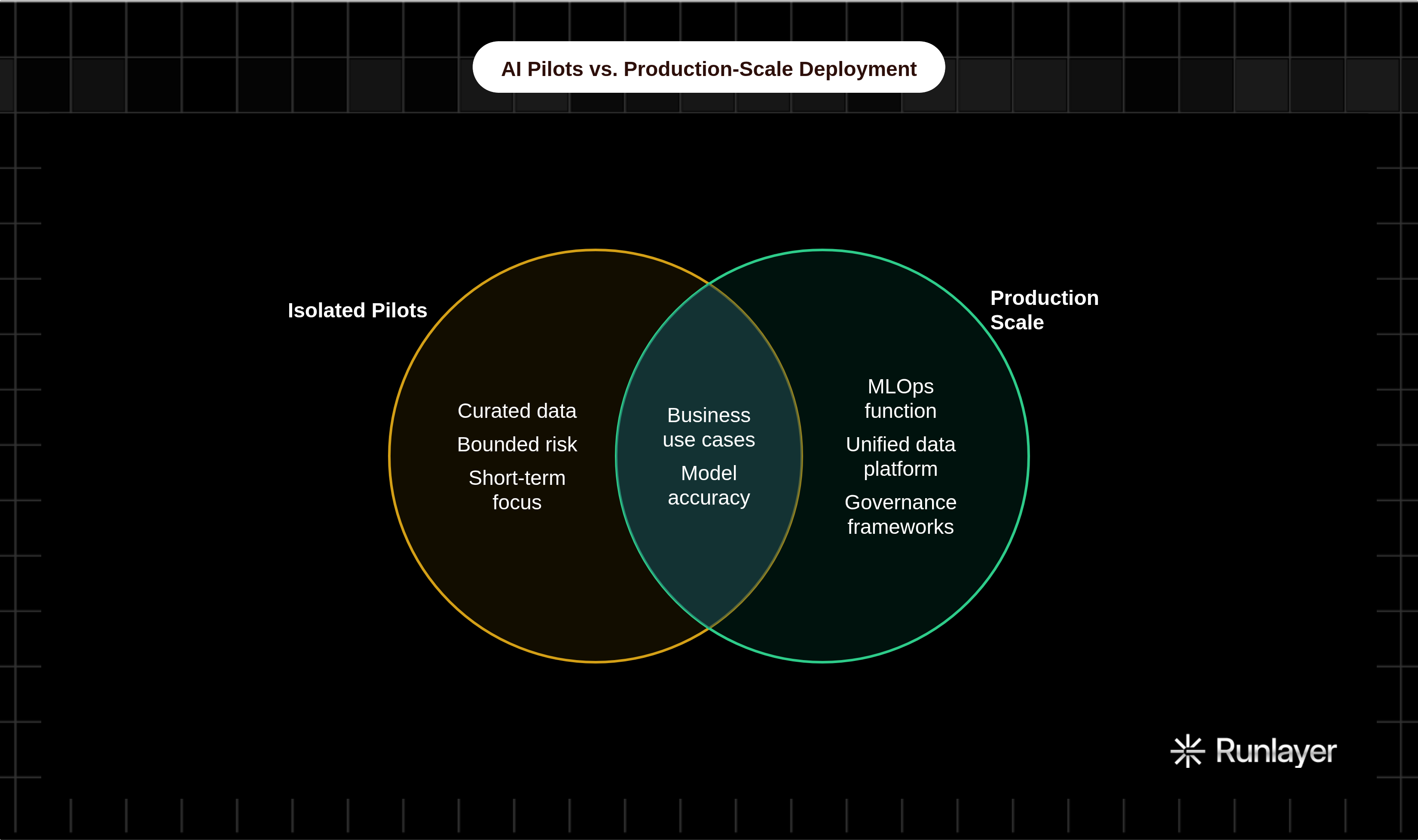
Fewer than 15% of enterprises have moved AI beyond isolated pilots into production-scale deployment. The rest are accumulating fragmented experiments: parallel pilots, inconsistent infrastructure, no unified data strategy, no clear ownership. The gap between a proof of concept that impressed a steering committee and a system generating measurable business value is where AI investment goes to die. Closing that gap is the CIO's job, and the playbook is nothing like standing up a pilot.
Generative AI has raised the stakes in a specific way. Every business unit now arrives with its own AI agenda, which means scaling pressure no longer originates in IT. It comes from the board, from line-of-business leaders, and from vendors whose pitches have gotten good at sounding like strategy. The risk is not moving too slowly. The risk is scaling the wrong things, the wrong way, on a foundation that will not hold.
What Separates the 15%
The enterprises that have scaled share two structural traits, and neither is better models or more sophisticated tooling.
First, they built centralized AI platforms before they needed them. Shared infrastructure, shared governance, shared MLOps function, with business units owning their use cases on top of that foundation. Not the reverse, where each unit builds its own stack and someone later tries to stitch it together.
Second, they invested in data and infrastructure ahead of pilot failure rather than in response to it. Most organizations do the opposite: run pilots until something breaks, then diagnose the data problem they should have seen coming. The sequencing matters more than the technology choices.
The Architecture Problem Nobody Wants to Fund
Integrating AI into legacy systems is an architecture problem. Framing it as a tooling problem is how you end up with a budget that makes no sense to anyone except the engineers who built it.
Legacy systems were not designed to provide clean, consistent, low-latency data inputs that production AI requires. Every integration point is a potential failure mode, and those failure modes do not announce themselves during a pilot running on curated data.
Model management compounds this at scale. One model in production is manageable. Dozens of models across business units, each with its own versioning, retraining cadence, and performance baseline, is a dedicated discipline. Without an MLOps function with real authority, model drift goes undetected. Performance degrades quietly. The business keeps making decisions on outputs that no longer reflect reality, and no one flags it because the dashboards are green.
Infrastructure costs do not scale linearly from pilot to production. Budget for 40 to 60% more than your pilot infrastructure suggests. Cloud compute, storage, monitoring tooling, and the engineering time to maintain all of it add up in ways that pilot-phase estimates reliably miss.
The Data Foundation
A model scales as well as the data feeding it. A 5% error rate in training data is a curiosity in an experiment. In a production system processing millions of decisions, it is a liability with regulatory implications.
Four infrastructure decisions determine whether your data foundation holds. Architecture coherence first: most enterprises have fragmented data lakes, and moving toward a unified platform is a prerequisite for reliable AI at scale, not a nice-to-have. Pipeline timing second: use cases requiring low-latency outputs need real-time infrastructure, and retrofitting batch pipelines after deployment is expensive while the business case for fraud detection or dynamic pricing dissolves around you. Interoperability third: AI systems that cannot exchange data with adjacent systems create islands, and enterprise AI requires data to move across business units, not pool within them. Ownership fourth: every dataset used in production AI needs a defined owner accountable for quality, access controls, and compliance. Without it, accountability dissolves when something goes wrong, and something will go wrong.
A common data vocabulary across the enterprise is not administrative overhead. It is what allows a model trained in one business unit to be evaluated, trusted, and reused in another. Organizations that treat this as a governance checkbox pay for it later in duplicated effort and incompatible outputs.
Governance as Infrastructure
Organizations that skip governance frameworks in the name of speed spend more time firefighting downstream failures than they saved. This is an operational observation about where time and money go, not a position on responsible AI.
Risk multiplies with scale in ways that are easy to underestimate. A model influencing decisions in one business unit carries bounded risk. A dozen similar models operating across the enterprise and shaping hiring, lending, pricing, or clinical recommendations carries regulatory, reputational, and ethical exposure the board cannot assess without structure you provide to them.
Establish roles before deployment. Model owners are accountable for performance and drift. Risk officers review models before production. An AI ethics function evaluates bias, fairness, and explainability requirements specific to each use case. These roles need decision-making authority, not advisory titles.
The EU AI Act classifies systems by risk level and imposes concrete obligations on high-risk applications. US executive orders signal federal scrutiny that will sharpen. Finance and healthcare regulators are already asking about model explainability and auditability. Organizations building governance infrastructure now will have a compliance advantage that is genuinely expensive for competitors to replicate after the fact.
Connecting AI to Business Outcomes
AI initiatives disconnected from business value get defunded. Every AI initiative needs a business owner, not just a technical sponsor. The CIO's role here is translation: converting technical capabilities into value propositions that CFOs and line-of-business leaders can fund and defend. Joint ownership models, where the CIO and a business unit leader share accountability for outcomes, produce higher rates of sustained investment than technology-led projects with advisory business stakeholders who can walk away when results disappoint.
Prioritize use cases on two criteria: impact and feasibility. High-impact, high-feasibility opportunities generate early wins that build organizational confidence and fund the next wave. Starting with the most technically ambitious use case is a natural instinct that reliably fails. Start with what can produce visible results in 12 months, then use that credibility to fund the harder problems.
The roadmap needs to distinguish between short-term wins and long-term platform investments explicitly, because they are not the same type of initiative. Short-term wins prove value and maintain executive support. Platform investments, including shared data infrastructure, MLOps tooling, and governance frameworks, create the compounding foundation. Both matter, on different timelines, with different success metrics.
Measuring What Actually Matters
AI ROI is harder to measure than traditional IT ROI because benefits are often indirect and long-horizon. Attribution is genuinely difficult when AI augments human judgment rather than replacing a discrete process. Pretending otherwise produces measurement systems that look rigorous and tell you almost nothing.
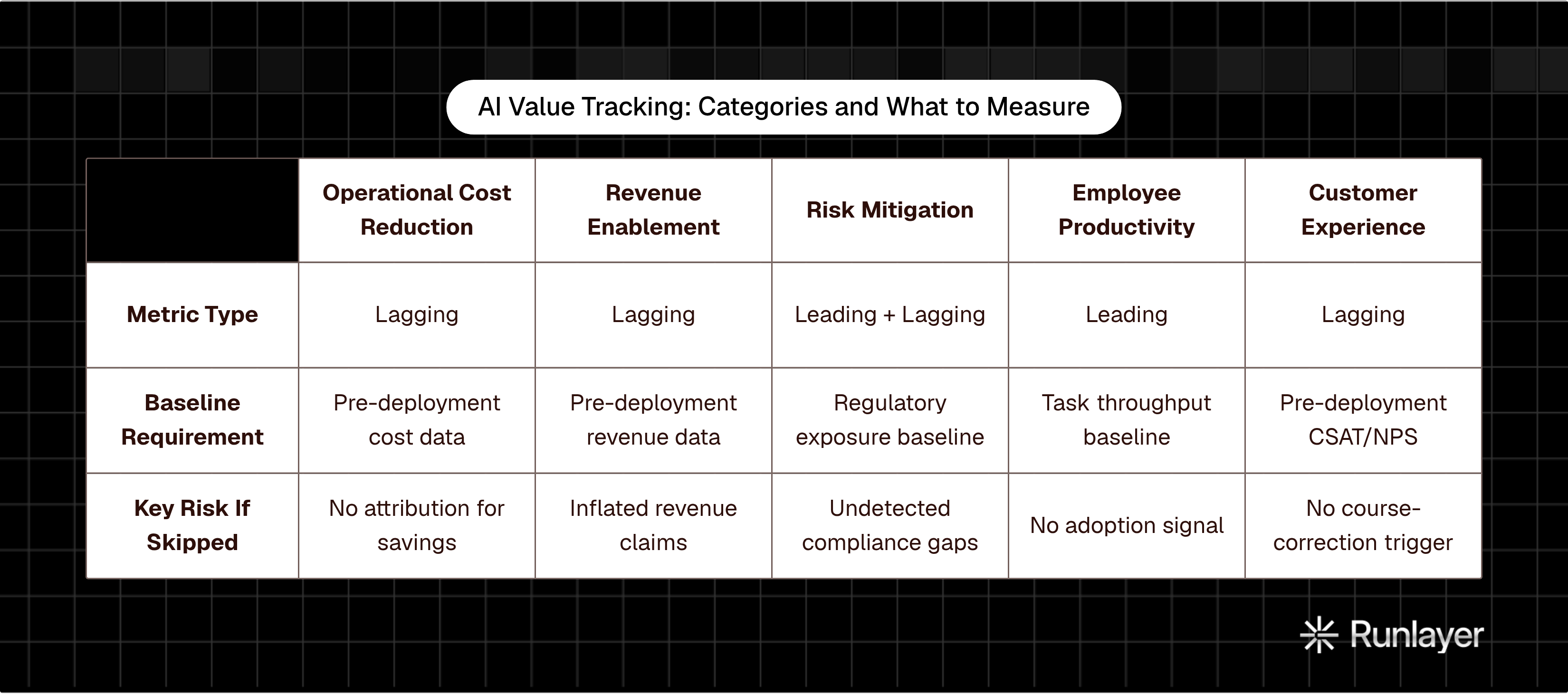
Track value across five categories: operational cost reduction, revenue enablement, risk mitigation, employee productivity, and customer experience. Each requires its own metrics and its own baseline, established before deployment. Baselines established after the fact are rationalizations.
Use leading indicators alongside lagging ones. Model accuracy, data pipeline reliability, and user adoption rates are leading. Revenue impact and cost savings are lagging. Waiting only for lagging indicators means waiting too long to course-correct.
Connect model monitoring to business outcome tracking in a single reporting infrastructure. A model maintaining high technical performance while business outcomes degrade is telling you something specific about how the model is being used, or whether the underlying problem has changed. You need both signals in the same view.
Define exit criteria before deployment. An initiative not delivering against its business case after a defined evaluation period should be pivoted or shut down. Sunk-cost bias ends more AI programs than technical failure does, just more slowly and more expensively.
What to Do Now
Assess your current state across data readiness, governance maturity, strategic alignment, and measurement infrastructure. The gaps you find are the roadmap.
Organizations that build this foundation deliberately over the next two to three years will hold a structural advantage that late movers cannot close quickly. The enterprises still running fragmented pilots in 2027 will not be behind on technology. They will be behind on the organizational capability that makes technology produce results, and that is the slower, more expensive thing to build.