Why AI Adoption Is Becoming an Infrastructure Problem
Most organizations lack the infrastructure to move AI beyond pilots into production systems.
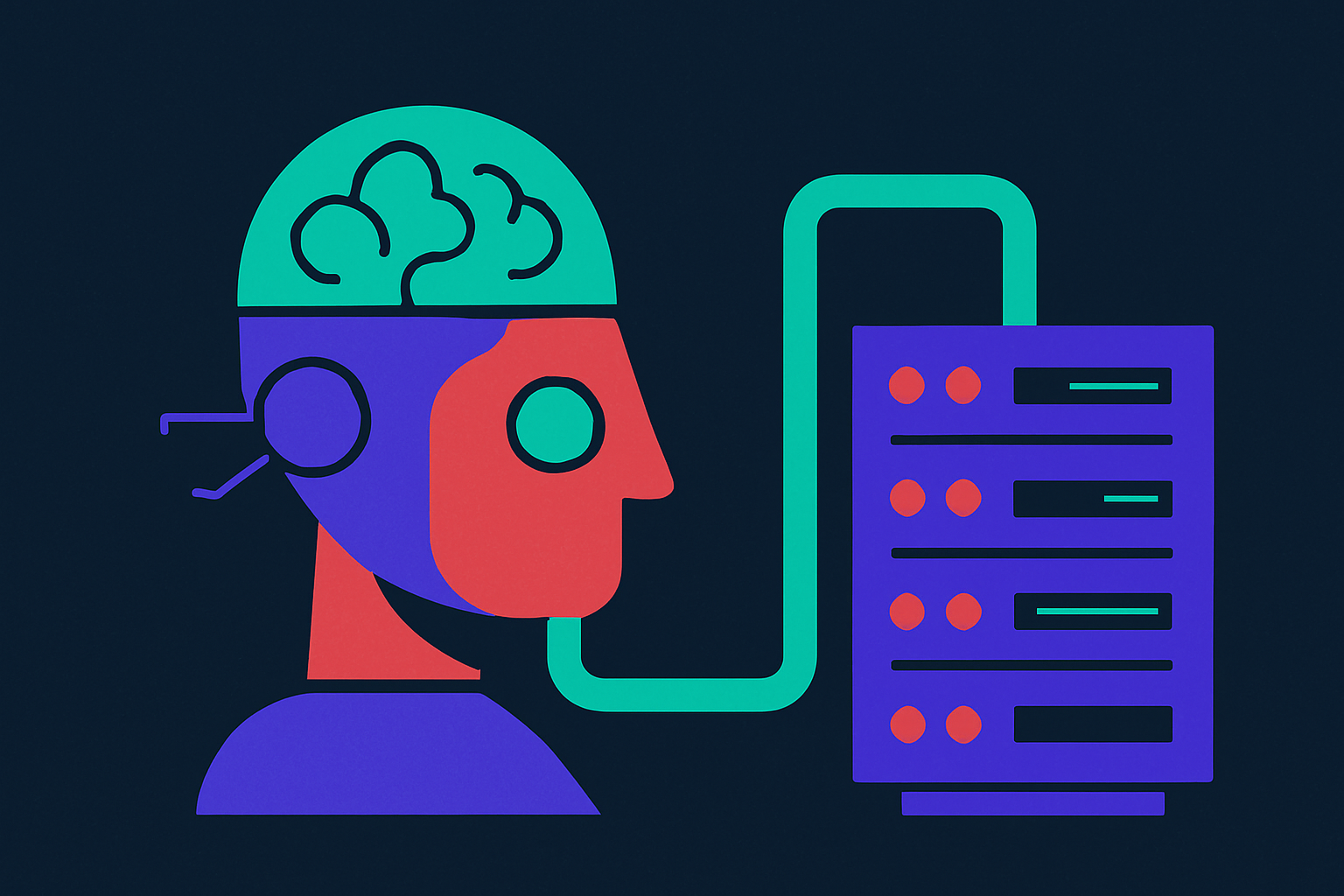
Why AI Adoption Is an Infrastructure Problem
The Real Barrier Isn't the Model
AI adoption is stalling inside organizations that have done everything right on paper. They bought the tools, hired the talent, ran the pilots. The models work. The business case exists. Deployment fails anyway.
The bottleneck is infrastructure, and most organizations are not treating it as such.
Three years of industry debate over model selection, prompt engineering, and data science headcount produced marginal gains. The structural constraint is the plumbing beneath the models. It was not built for this load.
The Old Adoption Framework Is Broken
The traditional view treated AI as a software procurement problem: pick a platform, find a use case, pilot it, measure accuracy, scale. That framing assumed existing IT could absorb AI workloads without modification. It measured progress in pilots launched and tools deployed. It left infrastructure to sort itself out.
The result is pilot purgatory. Organizations running 20 proofs of concept with zero in production. Models performing fine in sandboxes, collapsing under real data volumes, real latency requirements, real compliance scrutiny. The failure mode is not bad AI. It is infrastructure designed for a different era of computing, pressed into service for this one.
What Infrastructure Actually Means Here
Infrastructure in this context is every layer between a trained model and delivered business value: compute across cloud, on-premises, and edge; data pipelines and storage; networking and latency constraints; MLOps and deployment tooling; security and compliance layers; observability systems that catch model degradation before it becomes a business incident.
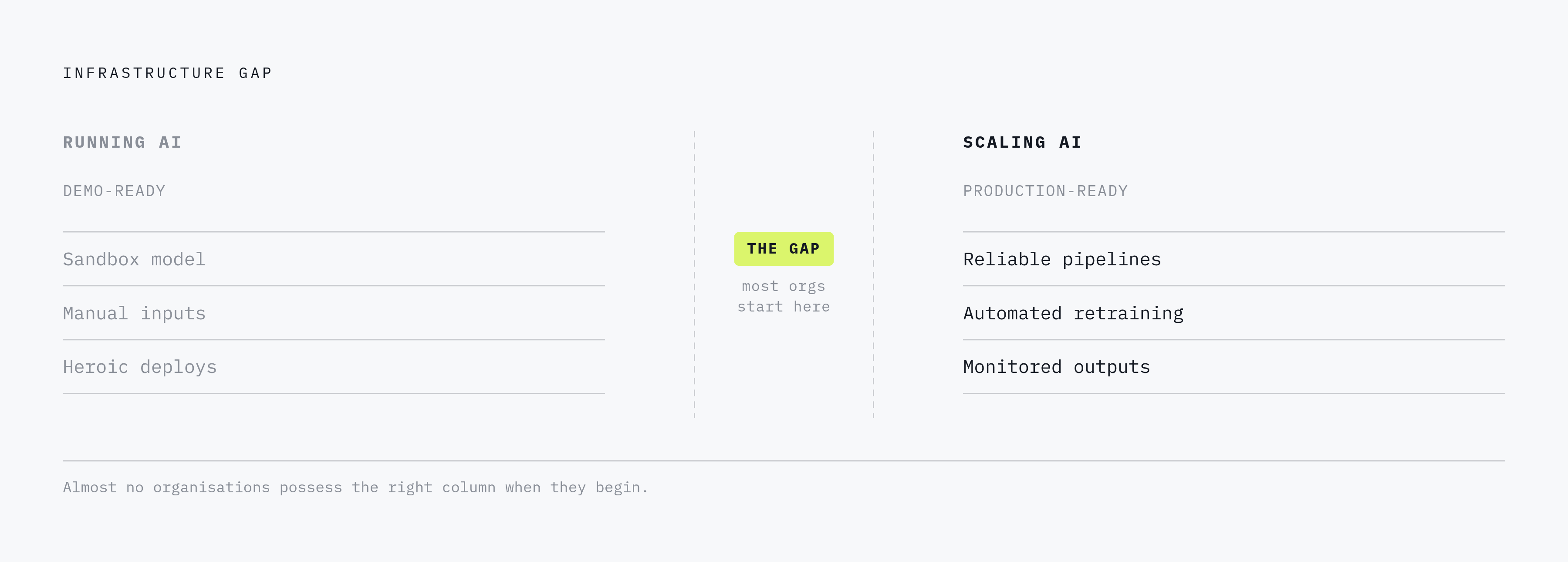
The distinction that matters is between infrastructure that runs AI and infrastructure that scales it. Running a model is a demo. Scaling requires reliable pipelines, automated retraining, consistent feature inputs, monitored outputs, and deployment that does not demand heroic engineering effort every single time. Most organizations have the first. Almost none have the second when they start.
How AI Is Breaking Existing Systems
AI workloads are structurally different from traditional enterprise workloads, and existing infrastructure reflects that gap in measurable ways.
GPU and compute demand is spiky and hard to predict. Storage systems designed for structured transactional data buckle under the volume and velocity of unstructured inputs. Real-time inference collides with batch-oriented architectures that were never meant to serve sub-second responses at scale.
Legacy databases do not handle vector data natively. Organizations deploying retrieval-augmented generation on top of relational databases built for CRUD operations learn this expensively. API rate limits and dependency bottlenecks create cascading failures that look like model problems but are routing problems.
Network bandwidth is the constraint that surprises engineering teams most often. Moving large model inputs and outputs across infrastructure not designed for that traffic adds latency and cost that appeared in no initial estimate.
Security is its own exposure. Traditional perimeter models were designed for known data formats and controlled application logic. Model inputs and outputs introduce attack surfaces perimeter thinking does not cover: prompt injection, inference-based data exfiltration, outputs that leak training data, compliance violations caught in review after deployment, and remediation costs that arrive when changing architecture is most expensive.
The Hidden Costs of Scaling
Visible AI infrastructure costs are compute and storage. The real costs sit elsewhere and compound.
Re-architecting data pipelines to reliably feed models is substantial engineering work. It does not appear in AI budgets, but it consumes engineering capacity. Cloud compute overruns from unoptimized inference are routine; the jump from prototype to production usage patterns is almost never modeled accurately in advance.
Engineering time spent on integration is time not spent on the product. Fragmented infrastructure means teams build bespoke connectors, manage tooling sprawl across business units, and solve identical plumbing problems independently. The same work, done five times, paid for five times.
Compliance retrofitting ranks among the most expensive line items organizations consistently underestimate. Regulators are not waiting. Building governance into systems after deployment means dismantling decisions already baked into architecture.
There is also the last-mile gap: the model is ready, but deployment infrastructure, access controls, monitoring, and rollback mechanisms are not. That gap is measured in months and engineering capacity that was never allocated. Each shortcut taken to close it faster becomes a structural ceiling on everything that ships afterward.
What AI-Native Infrastructure Actually Looks Like
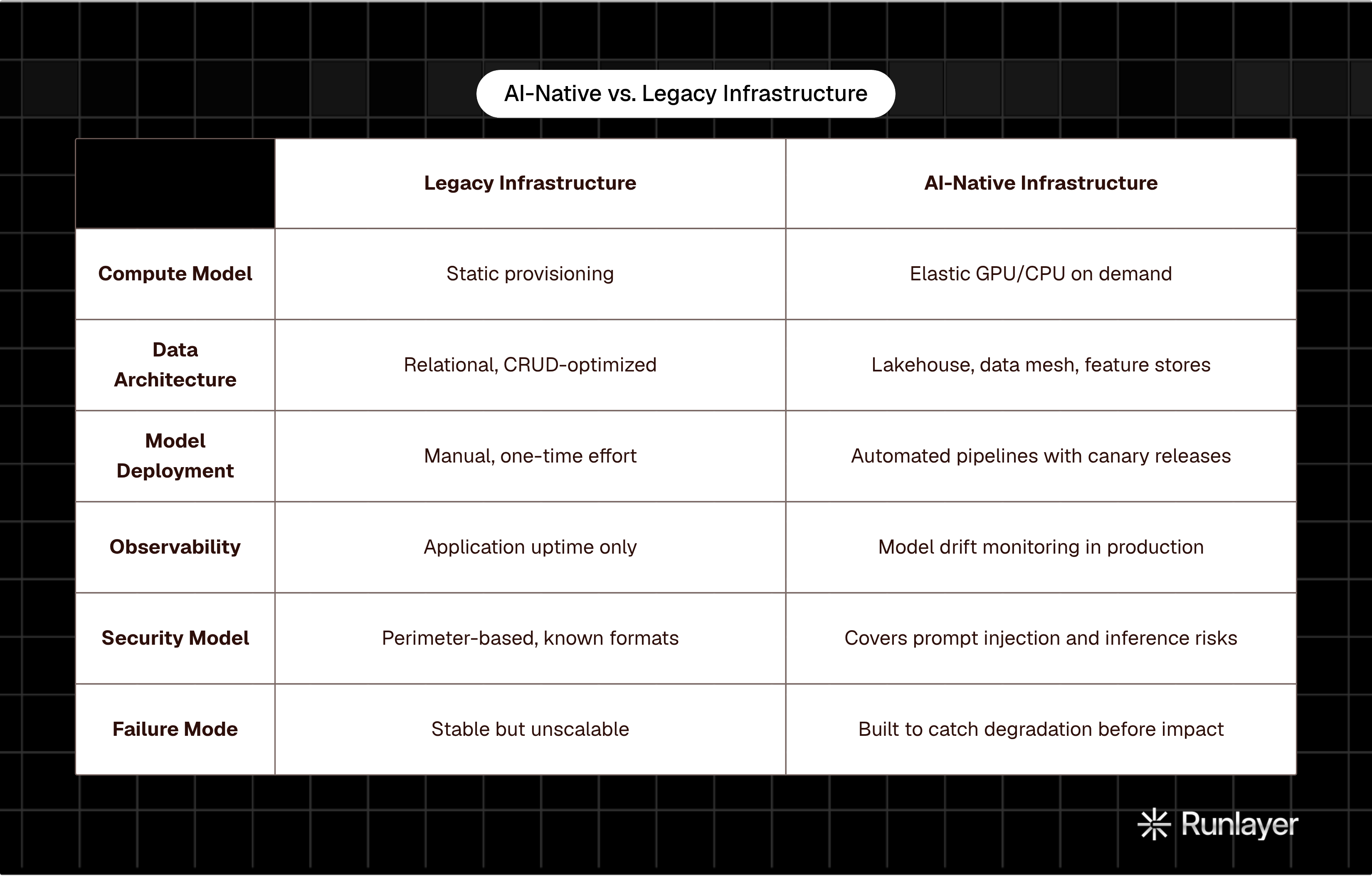
AI-native infrastructure treats AI as a first-class operational requirement from the start, not a workload to accommodate later.
Elastic compute designed for variable GPU and CPU demand is the foundation. Static provisioning for AI is either overbuilt and expensive or underbuilt and unreliable. There is no stable middle.
Data architecture determines model quality at scale. Lakehouse and data mesh patterns enable model-ready data access without funneling everything through a single bottleneck. Feature stores give consistent, reusable inputs across models and teams, which eliminates a recurring and underappreciated problem: different teams computing the same features differently and arriving at different answers, with no clean way to arbitrate.
Continuous delivery pipelines for models replace manual deployment processes that do not survive contact with scale. Models need automated testing, staging environments, canary releases, and rollback capability. Organizations without this ship once and hope.
Observability for model drift is not optional in production. A model accurate at deployment degrades as the world changes. Without monitoring, that degradation is invisible until it surfaces as a business failure, at which point the question shifts from "why is this happening" to "how long has this been happening."
Incremental migration beats waiting for perfect architecture. The practical path is identifying the highest-friction constraints, resolving them in priority order, and building toward AI-native architecture across release cycles. Open standards and interoperability are insurance against vendor lock-in; proprietary orchestration tooling extracts its price when requirements evolve faster than the vendor's roadmap.
The Ownership Problem
Organizational ambiguity about who owns AI infrastructure produces predictable failures.
Traditional IT owns compute and networking. Data teams own pipelines and storage. ML engineers own model development. Platform teams own deployment tooling. Security owns access controls. No single function owns the end-to-end path from raw data to model in production.
Model deployment falls through the gap between ML engineering and platform teams. Data quality is someone else's upstream problem. Security reviews land at the end of the process, when changing architecture is most expensive. This is not a personnel problem. It is a structural one, and it recurs reliably across organizations that have not explicitly solved it.
The organizations moving fastest have a dedicated AI platform or AI infrastructure function, not a coordination committee. A team with a mandate, a budget, and accountability for production reliability. It owns the connective tissue between data, compute, tooling, security, and deployment.
Leadership framing determines whether AI infrastructure is a cost center or a strategic capability. Organizations that classify it as overhead optimize it down until the constraint becomes visible in failed deployments and production incidents. Clear ownership at each layer eliminates the accountability gaps. Without it, every cross-functional dependency becomes a negotiation, and negotiations do not ship products.
What to Do Before the Next Initiative
GPT-4, Claude, Gemini, Llama, and whatever ships this quarter are capable of delivering real business value in production. The constraint is not model intelligence. It is infrastructure maturity.
Audit before you scale. Assess compute elasticity, data pipeline reliability, MLOps maturity, and security architecture before committing capital to the next initiative. Infrastructure investment made before scaling compounds. Infrastructure remediation made after a production failure costs more and moves slower; organizations that have been through it restructure their planning process and do not repeat it.
Your infrastructure is setting the ceiling on what you can ship. The audit tells you where that ceiling is. Run it now.