AI Security Perimeter Design for Agentic Workloads
Moving the security perimeter from network boundaries into agent workflows and tool calls.
Why Agentic Workloads Break the Assumptions Traditional Perimeters Are Built On
The traditional security perimeter rests on assumptions so foundational that most practitioners never examine them: protect the boundary, control ingress and egress, assume a human initiates every meaningful action. Those assumptions held because they roughly matched reality. They no longer do.
An agent doesn't wait for input. It plans, sequences tool calls, and executes across systems based on a goal it was given at session start. A single workflow might touch a file system, query a database, call a web API, and execute code, all without a human hand on the wheel between steps. The actor is non-human. The blast radius of a compromised session is entirely human-scale.
MCP, the Model Context Protocol introduced by Anthropic in late 2024, is what made this architecture mainstream. Claude, GitHub Copilot, and Cursor all adopted it natively, and it became the de facto standard for connecting LLM agents to external tools and data sources faster than most enterprises had time to evaluate the security implications. That speed matters. The governance lag isn't theoretical at this point; it's measurable.
The mechanism that makes MCP powerful is the same mechanism that creates the exposure. Tool selection and invocation are mediated by free-form natural-language descriptions, interpreted at inference time. Not by code logic a firewall can parse. Not by a schema a WAF can validate. The LLM reads a description of what a tool does and decides whether to call it. That decision happens inside the model, and there is no inspection point between the description and the action. Think of it as handing someone a master key and trusting them to only open the doors you meant — the key doesn't know the difference.
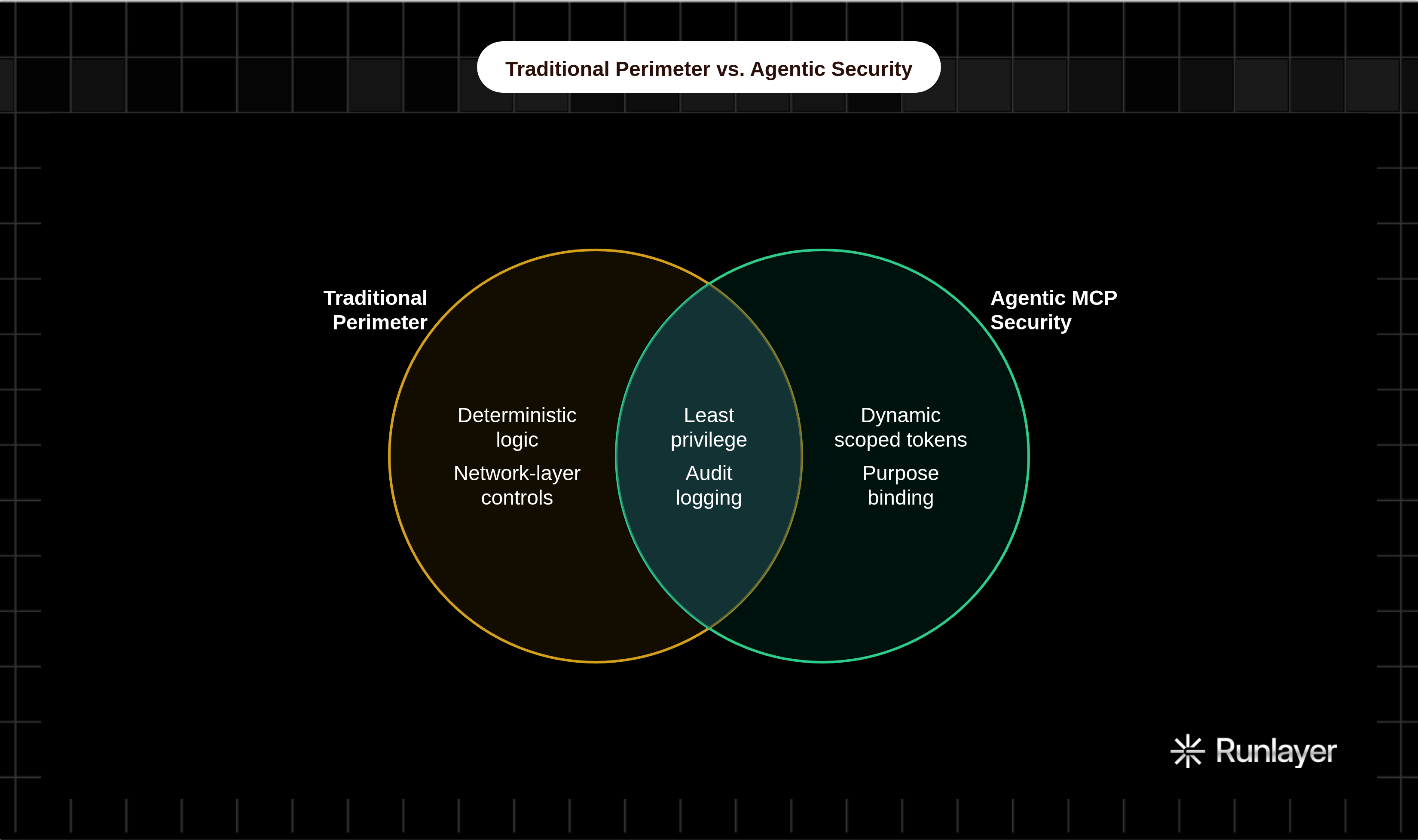
That's the core problem. The perimeter model assumes there is a layer of deterministic logic you can put policy in front of. With agents operating over MCP, that layer doesn't exist in the traditional sense. So the perimeter has to move: it has to become a policy layer that travels with every tool call, every credential, every chained action an agent takes.
The Governance Gap Enterprises Are Already Running Agents Inside
Here is where the situation stands operationally. Per the 2025 CSA and Google Cloud State of AI Security and Governance survey, only 26% of organizations have comprehensive AI security governance policies in place, and only 29% reported being prepared to secure agentic deployments specifically. The other 74% are governing agentic workloads with frameworks designed for a fundamentally different class of technology.
What that looks like in practice: agents running under those frameworks inherit whatever permissions their service accounts hold. Service accounts that are often over-permissioned, rarely scoped to a specific task, and almost never reviewed at the frequency that risk warrants. Nobody set out to build it that way. It just accumulated — like a junk drawer that somehow ended up holding the keys to the building.
The non-human identity problem compounds this considerably. The average enterprise environment carries somewhere between 82 and 144 non-human identities for every human identity. One in twenty of those carries full-admin privileges, and only 38% had been active within the last nine months, per 2025 research. That's a sprawling inventory of machine credentials, most of which no one is actively monitoring. Agents add to that count automatically: every new deployment is a new machine identity, typically without the scrutiny applied to a privileged human account.
The operational control gaps are just as stark. Research from Kiteworks' 2026 Forecast found that 63% of organizations cannot enforce purpose limitations on agents and 60% cannot terminate a misbehaving agent. The governance gap isn't missing policy documents. The runtime controls, the ability to constrain what an agent does and stop it when it goes wrong, simply don't exist yet for most organizations.
Forrester has predicted that an agentic AI deployment will cause a publicly disclosed breach in 2026, with governance failures as the root cause, not sophisticated attackers. The threat isn't an adversary who breaks through your defenses. It's an environment where the defenses were never built.
The Threat Classes Specific to MCP That Perimeter Design Has to Account For
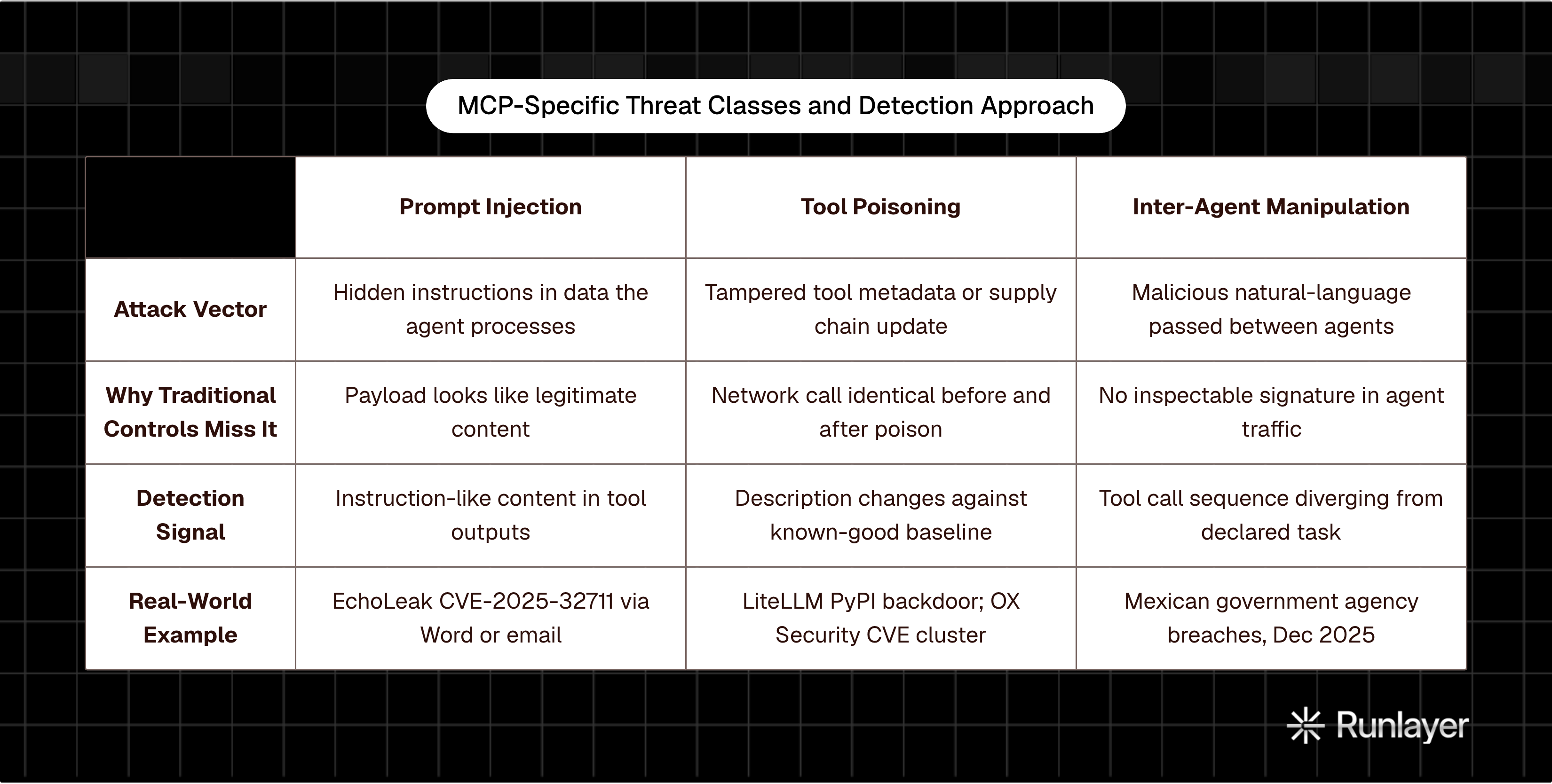
There are three primary threat classes. Each is qualitatively different from traditional application-layer threats, which is precisely why traditional controls miss them.
Prompt injection and goal hijacking. An attacker embeds hidden instructions in data the agent processes: a web page, a document, a tool output, an email. The agent reads the content, interprets the embedded instruction as legitimate input, and acts. It accesses credentials. It exfiltrates data. It calls an attacker-controlled endpoint. The user sees nothing unusual.
The EchoLeak vulnerability, CVE-2025-32711, against Microsoft 365 Copilot demonstrated this at production scale. A hidden prompt in a Word document or email caused Copilot to silently exfiltrate sensitive data with zero user interaction when asked to summarize the file. No special privileges required. No user error beyond opening a document. Multi-turn prompt injection, where malicious instructions unfold across successive prompts rather than all at once, achieved success rates as high as 92% across eight open-weight models in controlled testing. The distribution across turns is what makes it hard to catch; no single exchange looks anomalous.
Tool poisoning and supply chain tampering. The natural-language description of a tool is what the LLM reads to decide whether and how to call it. Poisoning that metadata poisons the agent's decision-making, through invisible Unicode characters in data sources or malicious function updates pushed to previously benign tools after installation, a pattern directly analogous to malicious browser extension updates.
The LiteLLM supply chain compromise backdoored approximately 47,000 machines in roughly 40 minutes through PyPI. The OX Security MCP CVE cluster affected more than 200,000 server instances across more than 10 CVEs in a single release. GitHub Copilot pull request descriptions, CVE-2025-53773 at CVSS 9.6, saw a hidden prompt injection trigger remote code execution. These are not theoretical attack paths.
Insecure inter-agent communication. When agents orchestrate other agents, a compromised agent can manipulate downstream agents through MCP traffic, shared memory, or coordination protocols. The attack surface is invisible to conventional network monitoring because the manipulation happens in natural language passed between agents, not in inspectable packet payloads. There is no signature to match against meaning.
The common thread across all three: the LLM is simultaneously the processor and the decision-maker. The attack lives in the same channel as the legitimate work. It's like trying to screen for a forged letter when the forger is also the one running the mailroom.
Between December 2025 and January 2026, a single attacker used Claude to breach multiple Mexican government agencies, including the federal tax authority and the electoral institute. Operational impact, not proof-of-concept.
Identity at the Action Layer: How Agents Authenticate to Tools and Why Static Credentials Fail
The default pattern in early MCP deployments was API keys stored in configuration files or environment variables. Static, shared, unscoped. GitGuardian's State of Secrets Sprawl Report 2026 found approximately 24,000 secrets in MCP configuration files on public GitHub alone, with Google API keys accounting for nearly 20% of exposed secrets. More troubling: 64% of credentials confirmed as leaked in 2022 were still active and exploitable in January 2026. A leaked key doesn't degrade over time. It just waits.
The LangChain Core vulnerability, CVE-2025-68664 at CVSS 9.3, illustrated the cascading risk directly. Prompt injection triggered the serialization system to dump environment variables, exposing every secret stored there. Static credentials in environment variables are not a storage strategy; they are a single point of failure waiting for a trigger.
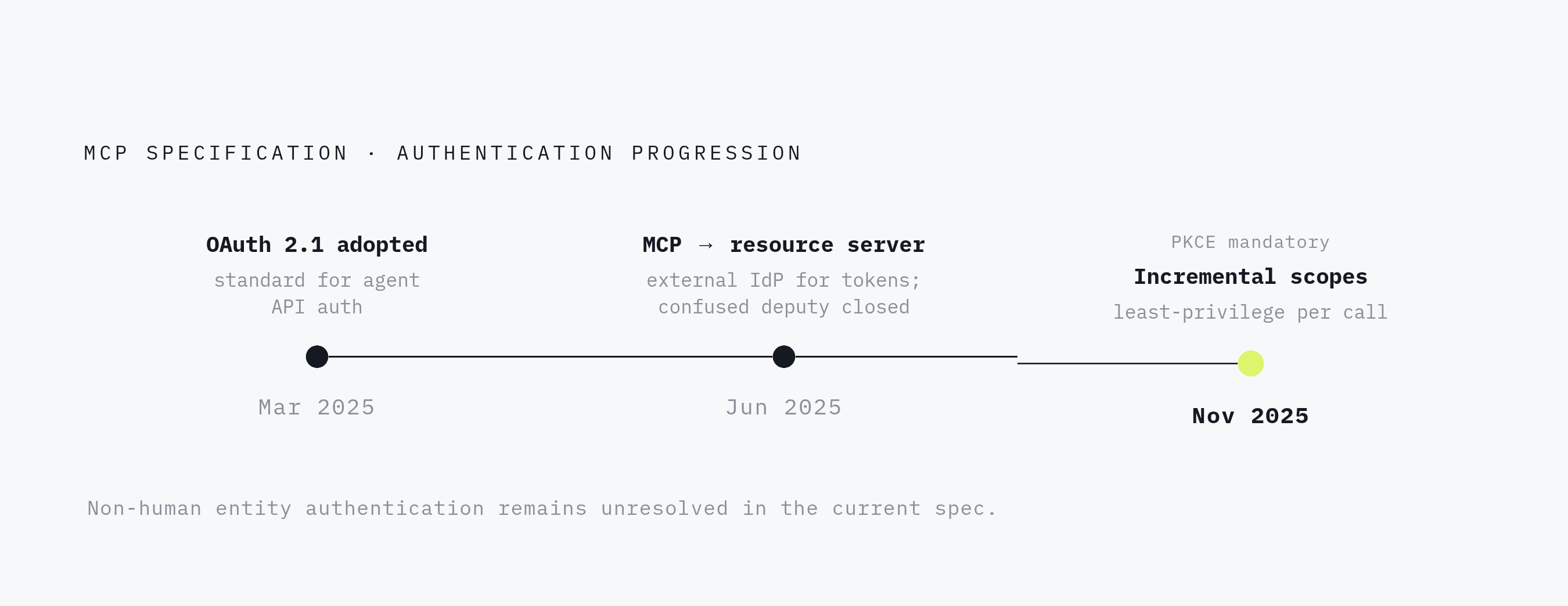
The MCP specification has evolved to address this, and the progression is worth understanding concretely. In March 2025, OAuth 2.1 was defined as the standard for authenticating agents against APIs. By June 2025, MCP servers were redefined as OAuth resource servers, token issuance moved to external identity providers, and the specification explicitly prohibited servers from passing tokens through to upstream APIs, closing the confused deputy vulnerability where a server acts on behalf of an agent with more authority than it should have. By November 2025, PKCE became mandatory for all client-side applications. Because agents, containers, and serverless functions cannot securely store client secrets, PKCE's verifier-challenge pair ensures that only the original requestor can exchange an authorization code for a token. Incremental scope requests arrived in that same update, allowing agents to request only the scopes needed for the current step rather than holding an over-permissioned token across the entire session.
One gap the specification leaves open: PKCE ensures the integrity of the token exchange but does not prove who is making the request. How non-human entities and autonomous workloads authenticate to the authorization server itself remains unresolved in the specification.
Sound architecture given that gap looks like this: agents hold their own scoped OAuth token to invoke a tool; the downstream service credential lives inside the MCP server's backend, retrieved from a vault at call time. The agent never touches the raw credential. Credentials are issued dynamically, scoped to the specific task, and bound to the agent's identity. The GitGuardian data is unambiguous: long-lived secrets are the dominant policy violation pattern, and the consequences are not hypothetical.
Policy Enforcement at Tool Depth: What Least-Privilege Means When the Actor Is an Agent
Network-level and service-level access controls are necessary but insufficient. An agent with access to a CRM tool doesn't just need read access to the CRM. It needs a policy that distinguishes read-contact from update-contact from delete-contact, applied per call, per context, per data classification. Traditional role-based access control assigns roles to users. Agents don't have stable roles. Their permissions need to vary by task, by context, by what data they're touching at a given step.
The permission creep problem is structural, and there's a useful taxonomy emerging around what practitioners are calling agent sprawl: functional duplication, shadow agents, orphaned agents, permission creep, and unmonitored delegation chains. Each represents a way that initially well-scoped permissions drift. Only 37% of organizations enforce purpose binding on agents per the Kiteworks 2026 Forecast data, meaning the majority of deployed agents retain permissions well beyond the specific task for which they were provisioned.
Tool-depth policy enforcement means every tool call passes through a policy check before execution. That policy is tied to the agent's identity, the tool being called, the scope of the call, and the data classification of what's being accessed. The incremental scope request pattern from the November 2025 MCP spec update makes this tractable in practice: because agents request only what they need for the current step, policy checks operate on minimal-surface requests rather than trying to adjudicate against a sprawling blanket permission set.
Inter-agent trust is a specific subproblem here. When agents orchestrate other agents, each agent-to-agent call needs its own trust boundary. A downstream agent should not inherit the full permissions of the orchestrating agent; that pattern collapses least-privilege as soon as you have more than one agent in a chain. Mitigations include signed inter-agent messages, MCP gateways that inspect and control inter-agent traffic, and explicit trust policies between named agent identities. The gateway layer is where this becomes operationalizable at scale.
Kill switches and purpose binding are operational policy controls, not conveniences. Only 40% of organizations have implemented kill switches per the Kiteworks data. The ability to terminate a misbehaving agent, immediately, without human escalation chains, is a policy requirement. Purpose binding means an agent provisioned to process invoices cannot be redirected to read HR records, even if its token technically scopes to both services. That constraint has to be enforced at the gateway, not trusted to the agent.
Real-Time Detection for MCP-Specific Threats: What to Monitor When the Attack Surface Is Natural Language
Conventional SIEM and network monitoring miss MCP-specific attacks for a structural reason. Prompt injection arrives in the payload content of a tool response, not in a malformed packet or an anomalous connection. Tool poisoning changes the behavior of a tool at the description layer; the network call looks identical before and after the poison. Intent drift happens gradually across a multi-turn session; no single call triggers a threshold. The attack surface is semantic, and most monitoring infrastructure is syntactic. You're essentially trying to catch a pickpocket by watching the door — by the time the network log shows something left, the wallet is already gone.
Detection for MCP-specific threats has to cover several distinct patterns. For prompt injection: inspect tool outputs and data returned to the agent for instruction-like content before it's processed, and flag calls that follow anomalous data ingestion with credential access or exfiltration patterns in subsequent steps. For tool poisoning: verify tool descriptions and schemas against known-good baselines, and alert on description changes between sessions, particularly for tools with broad permissions. For intent drift: compare the agent's current tool call sequence against the declared task or workflow, and flag when the sequence diverges from the expected pattern for that task type. For exfiltration: monitor data volume and destination in tool outputs, specifically for calls to external endpoints following data-retrieval steps.
The audit logging gap makes all of this harder than it should be. The current MCP ecosystem lacks a standardized approach to audit logging and traceability. The Astrix Security State of MCP Server Security 2025 report found a significant proportion of publicly accessible MCP servers exposed sensitive credentials, lacked transport security, or contained exploitable input validation flaws. Servers that aren't hardened can't produce reliable audit data even if you build detection infrastructure on top of them. You're trying to reconstruct events from a foundation that wasn't designed to support that.
Useful telemetry at the tool-call layer is specific. Every tool invocation should be logged with the agent's identity, the tool called, the scopes used, the inputs passed, the outputs returned, and the timestamp. OpenTelemetry tracing across the full agent session, not just individual calls, is what makes multi-step attacks reconstructable after the fact. One constraint that is non-negotiable: logs must sit outside the agent's permission scope entirely. An agent that can write to its own audit trail can erase evidence of its own compromise.
Per the 2025 CSA and Google Cloud survey, 88% of organizations running AI agents reported a confirmed or suspected security incident in the past year, while only 6% of security budgets are dedicated to AI agent security. Something has to give.
Putting the Layers Together: What a Perimeter Architecture for Agentic Workloads Actually Looks Like
The three layers don't operate in sequence. They run simultaneously, and each one strengthens the others.
Identity at the action layer limits the damage a compromised session can cause. If the agent holds a scoped, short-lived token rather than a static admin key, the attacker who hijacks that session inherits only the narrow permissions the token carries. The blast radius is bounded before the attack even begins.
Policy enforcement at tool depth is what operationalizes least-privilege in an environment where permissions can't be assigned statically. Every tool call passes through a policy check that accounts for who the agent is, what it's doing right now, and what data it's touching. When an agent requests an elevated scope mid-session through the Step-Up Authorization Flow, that request is evaluated in real time against the task it was provisioned for. Purpose binding ensures that a redirected agent, one that's been manipulated through prompt injection or goal hijacking, hits a policy wall before it can act outside its declared function.
Detection and audit is what makes the other two layers durable. Identity and policy controls can be circumvented if a token is stolen, if a policy has a gap, if an inter-agent trust chain is exploited. Detection is what catches the attack in progress rather than discovering the breach weeks later through forensics. Session-level logging is what makes the investigation tractable when something does go wrong.
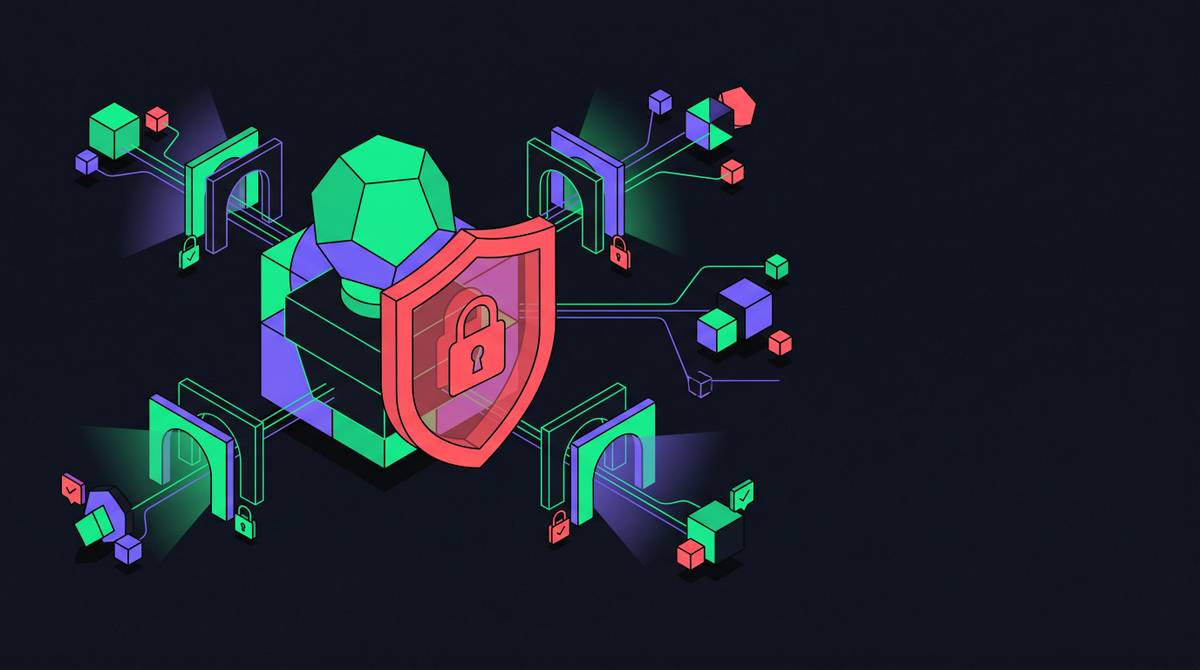
The MCP gateway sits at the center of this architecture. It is the enforcement point where identity is verified, policy is applied, and tool calls are logged before execution. It inspects inter-agent traffic. It enforces kill switches. It is the single layer that sees every action before it happens.
This architecture has no completion date, and anyone who tells you otherwise is selling you something. New CVEs, new attack patterns, new supply chain vectors are appearing faster than any static control framework can absorb. The architecture has to be designed for continuous adaptation, with the MCP gateway as the control plane where new policy can be deployed without redeploying the agents themselves. The organizations treating this as a one-time deployment problem will be the ones validating Forrester's 2026 prediction from the inside, and probably writing the post-mortem about governance gaps they knew existed.