AI Guardrails Implementation for Agentic Pipelines
Why AI agents need new defenses against natural-language attacks.
The Model Context Protocol lets an AI agent choose which tool to call and what arguments to hand it, and that choice is made by the model reading a plain-language description, not by a deterministic code path checking a schema. That single fact changes what "trust boundary" means. It is a sentence of natural language that an attacker can rewrite, not a firewall rule or a validator rejecting malformed input.
Why agentic pipelines break the classical API security model
Classical API security runs on a simple contract. A caller presents credentials, a gateway checks them against a schema, and the call either passes or it fails. The payload is structured. Nothing in that chain reads meaning into the request, and that absence of interpretation is why it has held up for decades of web and mobile traffic.
MCP breaks that contract at the point where the model, not the gateway, decides what happens next. The Cloud Security Alliance's MCP Security Best Practices guide lays out three separate trust boundaries that this creates: the LLM-to-client boundary, where the model reads tool descriptions and decides what they mean; the client-to-server boundary, where authentication is frequently missing altogether; and the server-to-downstream-system boundary, where permissions are routinely broader than the task requires. These are not three independent risks to patch separately.
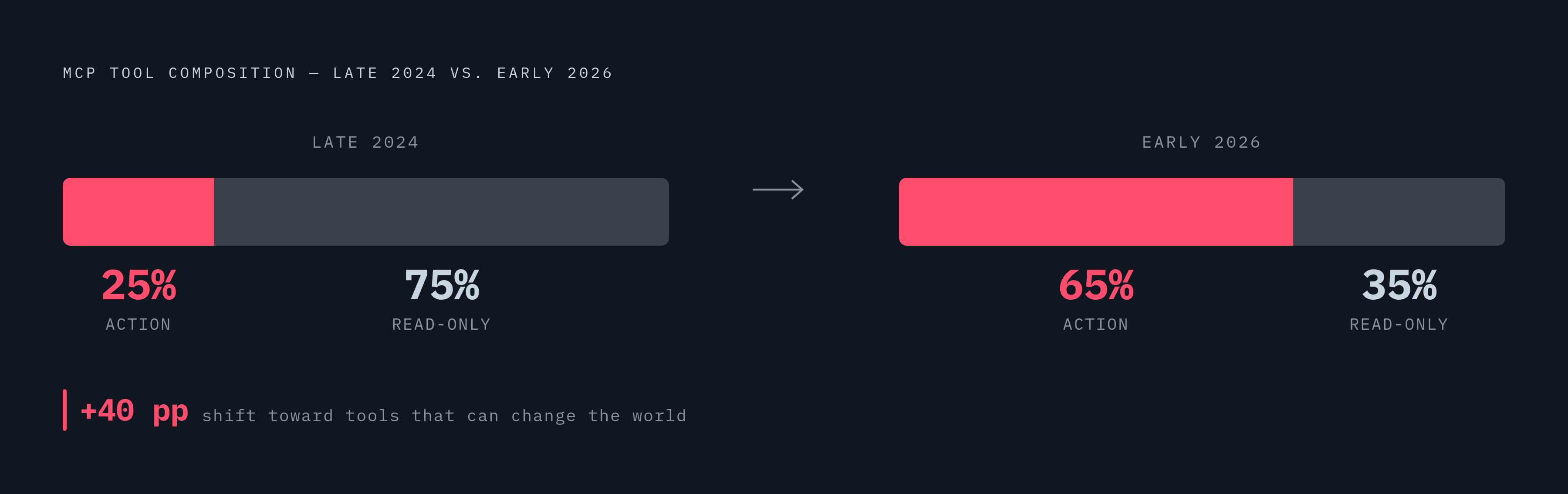
The shape of what sits on the other side of that handoff has also changed. The MCPSHIELD framework paper models MCP interactions as state transitions across systems annotated with trust boundaries, and it found that "action" tools, the ones that can directly modify something in the outside world rather than just read from it, grew from roughly a quarter of all tools in late 2024 to nearly two-thirds by early 2026. Most of what an agent touches today can change something, not just report on it. If a model misreads a malicious instruction, it no longer just returns bad data. It's taking an action with consequences attached.
The clearest demonstration of what that combination produces is the EchoLeak attack, tracked as CVE-2025-32711, against Microsoft 365 Copilot. It required nothing from the user, not a click, not an open attachment. A crafted email alone caused the agent to silently pull emails, chat logs, OneDrive files, SharePoint content, and Teams messages and send them to an attacker's endpoint. Every guardrail described later in this piece exists to put something back in that gap.
The four attack classes that define the MCP threat surface
Four attack classes fall directly out of that structural gap, and none of them has a direct equivalent in classical API security, because each one exploits a point where natural language, not code, is making the decision.
Tool description poisoning is the first. An attacker writes malicious instructions into a tool's description field, the LLM reads those instructions as legitimate guidance, and it acts on them without ever touching an authentication check or a schema validator. Invariant Labs demonstrated this against the Cursor IDE with a proof-of-concept hidden inside a calculator tool. The tool's description contained a hidden instruction that caused the agent to read the user's SSH private key and send it out as an extra parameter in a routine tool call to a remote endpoint. The user's screen showed nothing unusual, just truncated, benign-looking text.
Indirect prompt injection is the second, and it moves the attack from the tool's description into the data the tool returns. The agent reads a tool's output, treats instructions embedded in it as directives, and so it sometimes calls tools it was never told to call. This is what happened in the GitHub MCP server incident documented in 2025, where a file inside a repository carried adversarial instructions that hijacked the agent's next steps.
Parasitic tool chaining and cross-server shadowing form the third class. Here a compromised tool pushes the agent to invoke other tools outside the workflow it was approved for. Invariant Labs showed how a single malicious MCP server can weaponize the trusted servers sitting next to it: it injects hidden instructions into the shared context window through its own tool description and steers the agent's behavior toward tools it never compromised directly.
The fourth class is supply chain compromise, and it is the one with the most evidence behind it. By February 2026, the Sandworm_Mode campaign had used npm typosquatting to plant rogue MCP servers inside Claude Code, Cursor, Continue for VS Code, and Windsurf. Check Point Research separately found remote code execution in Claude Code through poisoned repository config files, and Antiy CERT confirmed 1,184 malicious skills sitting inside ClawHub, the marketplace for the OpenClaw AI agent framework.
The most consequential entry in this class is not a single malicious package but a default baked into the protocol's own reference implementations. OX Security's disclosure, titled "Mother of All AI Supply Chains," found that the STDIO transport inside Anthropic's official SDKs, across Python, TypeScript, Java, and Rust, passes configuration parameters straight to the host operating system's shell without sanitizing them first. That one design choice left an estimated 200,000 instances vulnerable, inside a supply chain that has seen more than 150 million package downloads. It matters that this is a design default and not a bug in any one product, because it means every project that trusted the official SDK inherited the same hole, regardless of how carefully that project was otherwise built.
A fifth dimension cuts across all four classes and rarely makes it into practitioner checklists: time. A layered attack surface survey separates threats into instantaneous ones that resolve within a single tool call (T1), session-persistent ones (T2), cross-session cumulative ones where memory poisoning builds up across multiple sessions (T3), and sub-session-stack threats (T4). None of the benchmarks the survey examined evaluated T3 or T4 threats at all, so the slow, compounding attacks were simply unmeasurable in that corpus, though benchmarks published after the survey's April 2026 cutoff have begun to close that gap. If a control only inspects the current tool call, it catches T1 and maybe T2.
Why the authentication gap is the load-bearing structural failure
Everything above describes mechanisms attackers use once they have a foothold. The reason the foothold exists so often, on so many systems, comes down to something simpler: authentication was optional by specification, so the very first trust boundary, the one between client and server, is frequently just absent.
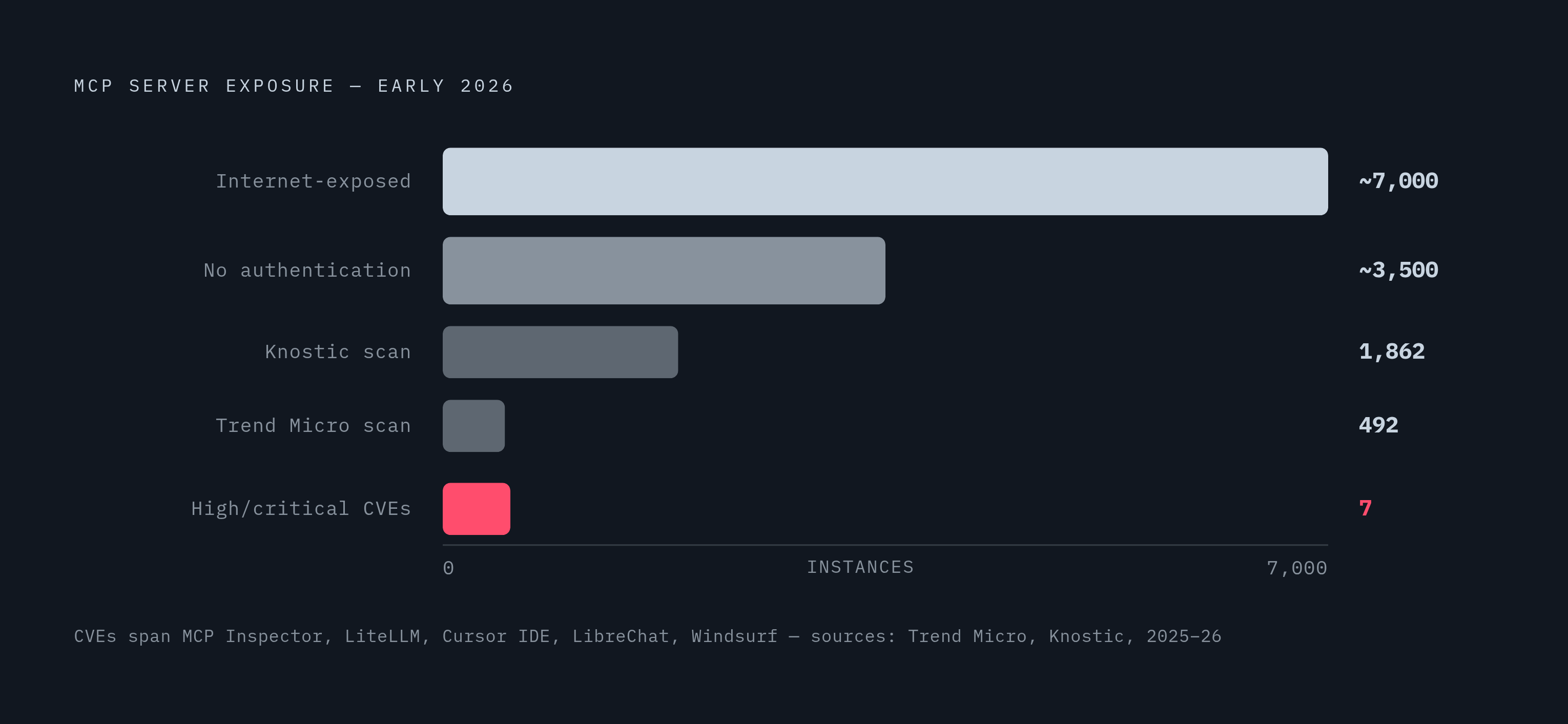
The scale of that absence is measurable. By early 2026, security researchers had catalogued close to 7,000 MCP servers exposed directly to the internet, and roughly half of them ran with no authentication controls at all. The original MCP authorization specification did define an OAuth 2.1 framework, but it marked the use of that framework optional rather than mandatory. An internet scan put a number on what that choice produced: Trend Micro found 492 publicly accessible MCP instances responding to unauthenticated requests, while Knostic's separate scan counted 1,862. The two studies used different methods and landed on different totals, but both point at the same open door. As of May 2026, at least seven confirmed high- or critical-severity CVEs span MCP Inspector, LiteLLM, Cursor IDE, LibreChat, and Windsurf, a spread across tooling, infrastructure, and IDE integrations that shows this is not confined to one vendor's product.
Missing authentication compounds through how enterprises typically connect agents to credentials. When an agent authenticates through a shared service account, every tool call it makes runs under that account's full combined privilege set, and the end user's actual permissions never enter the picture. If a credential leaks or is scoped too broadly, it then reaches everything the service account can touch across every connected system. So the agent's blast radius becomes the credential's blast radius, not the narrower blast radius of what the user actually intended to do. The reverse setup has its own failure mode: when an agent instead operates under a user's own delegated token, there is no way in the audit log to tell the agent's actions apart from the human's, and that token can be used for anything the user is permitted to do, far past the single task the agent was deployed to perform.
The specification itself is catching up to this problem, and the gap between where it stood and where it stands now matters. The MCP 2026-07-28 release candidate, published May 21, 2026 and described as the largest revision to the protocol since its launch, removes sessions entirely, drops the initialization handshake, and hardens authorization in two concrete ways. Servers must now implement OAuth 2.0 Protected Resource Metadata under RFC 9728, so a client can find out on its own which authorization server to talk to. Clients must implement Resource Indicators under RFC 8707, specifying which server a given token is meant for, which closes off a class of token theft where a malicious server intercepts a token intended for someone else. For agents that act without a human in the loop at all, the MCP OAuth Client Credentials extension lets them authenticate directly with an authorization server, either through reusable client secrets or through signed JWT assertions, and the signed-assertion path is the one the extension recommends.
None of that solves identity at the level that matters most for accountability. You still can't prove which specific agent or runtime is holding a given token under the revised spec. Verifiable workload identity sits outside the protocol's scope and has to be built separately by whoever deploys the system. That is the part the spec update does not touch, so the fix cannot be purely a protocol-level one.
Two technical controls belong in an implementation, because they map directly onto the gaps above: MCPSHIELD's formal verification model treats tool integrity as one of four fundamental security properties a system needs, and it proposes cryptographic attribution as the mechanism that makes integrity checkable: a tool's description gets bound to its server's identity, and any later modification to that description invalidates the signature. That gives a deployment a way to detect description poisoning at the moment it happens, rather than after an agent has already acted on it. On the supply chain side, an approved-server allowlist, maintained the way AWS Kiro's organization-level JSON registry does it, paired with package-provenance validation before any new MCP server is allowed to register tools, closes off the Sandworm_Mode and typosquatting pattern at the point of entry rather than after a rogue server is already running. You should treat any server using STDIO transport as untrusted by default, run it inside a sandbox, and never let it pass unsanitized configuration parameters to the host shell. On the authentication side itself, the practical pattern is OAuth 2.1 with PKCE for flows where a human user is consenting, JWT bearer assertions for service-to-service calls, and the MCP OAuth Client Credentials extension with signed JWT assertions specifically for agents acting on their own. AIUC-1's Q2 2026 standard has already moved to formalize this: it extends tool-call validation, meaning tool authorization and input/output validation together, to cover MCP server tool calls as an explicit compliance control under D003.1.
What ties all of this back to governance rather than pure engineering is a point raised about agent capability more broadly: the risk an agent poses is a function of what it is actually able to reach once it starts acting, not just what access it was granted, and those two numbers are rarely the same. An agent's documented scope and its practical reach can diverge the moment a credential is shared, a token is over-privileged, or a tool chain leads somewhere nobody mapped in advance. Closing the authentication gap matters because it is the first checkpoint in the pipeline. But no deployment is secure because its authentication spec is correct. It is secure because someone has actually traced what every credential in the system can reach, and updated that map as often as the agents themselves change.
Sources
- Agentic MCP Security Best Practices Guide
- AI Agent Security and MCP Defense Guide
- practical-devsecops.com
- MCP Security Crisis: Systemic Design Flaws in AI Agent Infrastructure
- A Formal Security Framework for MCP-Based AI Agents: Threat Taxonomy, Verification Models, and Defense Mechanisms
- AIUC-1 Q2 Refresh: MCP Security and Agent Identity Controls
- A Systematic Survey of Security Threats and Defenses in LLM-Based AI Agents: A Layered Attack Surface Framework