Enterprise AI Agent Deployment Patterns
Governance and audit trails separate production agents from prototypes.
Agentic AI is the broad category: systems that reason, plan, and take multi-step action without a human clicking "next" at every turn. An enterprise AI agent is a narrower thing entirely. It's agentic AI with governance, compliance, audit, and system integration built into the architecture from day one, not bolted on after a demo wows someone in a hallway. Most of what's floating around internal hackathons right now doesn't clear that bar, and it shouldn't have to. A hackathon prototype and a production system are different animals with different jobs, and treating them as points on the same line is where a lot of enterprise AI plans go wrong from the start.
The distinction matters because it sets the line for what "deployed" actually means. A CISO has to sign off on it. Every action needs to trace back to something auditable. It has to touch real enterprise data and real credentials, not a sandboxed mock API that nobody will ever point at a live database.
Four things separate the enterprise version from the prototype, and none of them are optional:
- Identity tied to every action the agent takes, not just the login session that started it
- Policy enforcement at the moment of the tool call, not just at the outer API gateway
- An audit trail that captures the reasoning steps, not just the input and the final output
- A memory architecture that tracks provenance: which data fed which decision, at which step
Building the agent itself is rarely the hard part anymore. Orchestration, governance, and wiring the thing into existing enterprise infrastructure (that's where projects stall, and that's where most of the money actually goes).
The deployment form most enterprises actually start with
Most enterprises don't start with some elaborate multi-agent system, and they shouldn't try to. They start with a single-agent pattern: one agent, one domain, one workflow, scoped tight around a bounded problem. IT helpdesk triage. Document summarization. Turning meeting notes into action items. Nothing glamorous, but it ships, and shipping is the whole point at this stage.
It works at proof-of-concept for a simple reason: it's easy to scope, easy to test, fast to build. It stalls at scale for an equally simple reason. A single agent can't cross system boundaries on its own, can't hand a task off to something better suited for the next step, and can't run a workflow that spans more than one department.
Governance at this tier is manageable. Teams skip it anyway, which is the mistake:
- Tool access scoped to the bare minimum the task needs
- Identity bound to the agent itself, not inherited from whoever's logged in
- A log of every tool call the agent makes, not just the final answer it spits out
Here's where it actually goes wrong, and it's rarely dramatic. A team doesn't graduate to a proper multi-agent pattern. Instead, they keep expanding the single agent's scope. One more tool. One more department's data. That's the exact moment shadow agent usage starts, quietly, with nobody signing off on any of it, and nobody noticing until an audit turns it up months later.
Sequential multi-agent orchestration and why it dominates production deployments
Sequential orchestration strings together a defined pipeline of specialist agents, each one handing its output to the next. Agent one's result becomes agent two's input, and so on down the chain. This is the pattern that actually works at scale, full stop, and nothing else on the market comes close right now.
Banking customer onboarding is the textbook case: five agents in sequence, running document verification, credit check, compliance screening, account agreement generation, and account provisioning. This setup is close to standard across banking customers now, tuned per institution's compliance regime but structurally the same everywhere you look.
Sequential orchestration wins in regulated industries because it maps directly onto what regulators actually ask for:
- Each step gets audited on its own, in isolation from the rest of the pipeline
- Failure is easy to find. One agent breaks, the pipeline halts, and the error points straight at the failure
- Compliance checkpoints line up naturally with workflow stages, so nobody has to force-fit a review process onto architecture that wasn't built for it
That's not a coincidence, and it's why banking, financial services, and insurance make up the largest single chunk of the enterprise agent market. Sequential orchestration fits compliance-heavy work the way a socket fits a wrench.
The governance demands shift the moment agents start handing work to each other. Every agent in the chain needs its own scoped identity; a single shared credential passed down the line kills the audit trail dead. The orchestrator running the pipeline needs its own identity and its own audit trail, separate from the agents it's coordinating. And data passed between agents needs a provenance tag showing which agent produced it, and at which step.
Parallel and hierarchical orchestration patterns for higher-complexity use cases
Parallel orchestration puts multiple agents to work on independent subtasks at the same time, with a coordinator pulling the results together at the end. Think competitive intelligence: several agents scraping, summarizing, and scoring different sources at once, or a risk analysis pulling from multiple data feeds in parallel.
The governance snag here is subtle but real. The coordinator has to reconcile outputs from agents that may have touched different data under different permission levels. Blend those access levels carelessly, and information that should've stayed siloed ends up sitting in a combined report that nobody scoped for that kind of exposure.
Hierarchical orchestration goes a layer deeper, and it's the pattern that should worry people most, not the newest or shiniest one. A planner agent breaks a goal into pieces and delegates to subordinate agents, who might delegate further down a third or fourth tier. This fits long-horizon work where the full plan can't be written out in advance: R&D workflows, multi-system incident response, that kind of thing.
The risk here has a name: intent drift. What a user authorized at the top of the chain may not match what a third-tier agent, several delegations removed, actually ends up doing. This isn't some theoretical edge case dreamed up in a whitepaper; intent drift sits alongside tool poisoning and prompt injection as one of the named threat categories specific to MCP-based systems.
Two structural shifts are worth tracking here. Microsoft retired both AutoGen and Semantic Kernel in October 2025, folding them into a single Microsoft Agent Framework, so any team still building on the older frameworks needs a migration plan now, not later. And in December 2025, Anthropic handed MCP over to the Agentic AI Foundation, under the Linux Foundation umbrella. That's a clear signal MCP is becoming shared infrastructure rather than one company's protocol to control.
Pattern choice isn't a one-time decision, either. Most enterprises start sequential, because it's auditable and contained, then move to hierarchical as their use cases get more ambitious. Governance has to move with that progression. Rebuilding it from scratch at every stage is how teams end up with three incompatible audit systems and no single source of truth.
How MCP became the integration layer beneath all of these patterns (and what that means for exposure)
MCP, the Model Context Protocol, is the standard way agents talk to tools, databases, and outside APIs now. People call it "USB-C for AI applications," and the comparison holds: one connector shape, plugged into everything.
That's exactly why it matters across every pattern above. Whether an enterprise runs one task agent or a four-tier hierarchical system, MCP is probably the layer handling the actual tool calls underneath. The orchestration pattern changes how big the blast radius is when something goes wrong. It doesn't change whether the risk exists in the first place, and that distinction gets lost in a lot of planning conversations.
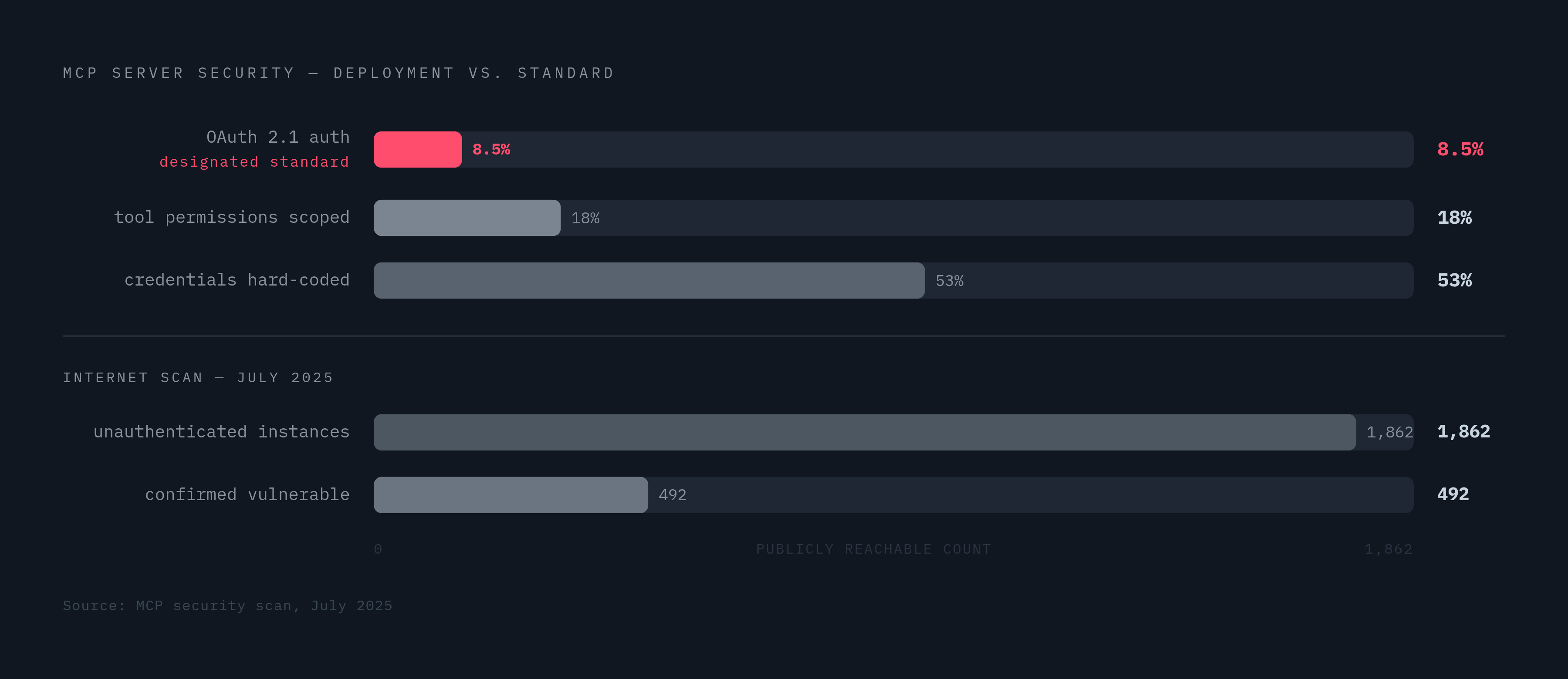
The risk isn't small, either. Only 8.5% of MCP servers currently implement OAuth 2.1 authentication, even as the protocol designates OAuth 2.1 as the standard for secure remote deployments. A scan of the public internet in July 2025 found at least 1,862 publicly reachable MCP instances answering unauthenticated requests. Separately, 492 MCP servers have been confirmed vulnerable to abuse — lacking basic authentication or encryption. Not theoretically vulnerable. Confirmed.
So every pattern running on MCP inherits this exposure by default, unless somebody actively closes the door. More orchestration complexity means more tool-call paths, and each one of those is a door of its own. Cloud-first deployments make up most enterprise agent rollouts, and most of those expose public MCP endpoints as the default setup, not as some rare misconfiguration someone forgot to catch.
The specific threat classes that enterprise agent deployments face at the MCP layer
A handful of named vulnerabilities show what this exposure looks like once someone actually exploits it, rather than just theorizes about it in a conference talk.
Tool poisoning happens when a compromised MCP server returns instructions that quietly change how the agent behaves. The MCPoison vulnerability in Cursor IDE, tracked as CVE-2025-54136 and nicknamed the "rug pull" attack, showed this at scale: a benign MCP configuration gets approved, then a later commit swaps in a malicious payload without anyone re-reviewing it.
Prompt injection through retrieval produced the first confirmed zero-click agent attack on record: EchoLeak, CVE-2025-32711, rated 9.3 on CVSS. A crafted email planted hidden instructions; Microsoft 365 Copilot pulled that email in as context later and acted on the buried instructions, no user interaction required at any point in the chain.
OAuth proxy exploitation hit harder still. CVE-2025-6514, rated 9.6, involved the mcp-remote OAuth proxy blindly trusting whatever OAuth endpoint a server claimed to be. A malicious server injected shell commands into that endpoint and ran arbitrary commands under the user's own privileges. Over 437,000 developer environments were exposed by this one alone.
Unauthenticated execution shows up in CVE-2025-49596, rated 9.4, where unauthenticated MCP Inspector instances allowed arbitrary command execution outright. No credential needed at all.
The real-world consequences aren't hypothetical. Asana shipped an MCP-powered feature in May 2025, and for two weeks, customer data bled across separate customers' MCP instances before the integration got pulled offline.
Credentials leak through a more mundane channel too: config files sitting in plain sight. GitGuardian's State of Secrets Sprawl 2026 report found roughly 24,000 secrets sitting in MCP configuration files on public GitHub. AI-assisted commits leaked secrets at about double the rate of human-written ones, which says something uncomfortable about how fast these tools get set up compared to how carefully they get checked.
None of these threats live in isolation, and that's the part that should actually keep security teams up at night. A supply chain compromise plants a poisoned MCP server. That server enables tool poisoning. A stolen session token gets reused. Tool poisoning exfiltrates a credential, which enables the next compromise down the line. Each vulnerability is bad enough alone; the way they chain together is the actual threat model enterprises need to plan against.
The credential and identity problem that every deployment pattern inherits
Enterprises now run non-human identities at a scale that far outpaces their human counterparts, and agents are adding to that count at deployment speed, not the slower pace of a planned migration.
Overprovisioned, stale credentials aren't the exception here; they're the baseline you should assume going in. Overprovisioned credentials are common across non-human identities, many of which carry far more privilege than the tasks they perform require. These credentials sit dormant until one gets used for something it shouldn't.
The MCP layer makes this specifically worse. Only 18% of MCP server deployments scope tool permissions in any meaningful way. 53% expose credentials as hard-coded values sitting in plain configuration files, which is roughly the security posture of leaving the office key under the doormat.
Supabase's incident lays this out cleanly. An agent running with privileged service-role access processed input an attacker controlled, and that privilege level is what turned a bad input into a successful exfiltration. Scope that same agent down to read-only, and the attack path doesn't exist anymore. There's no exfiltration to have, because there's nothing left for the agent to hand over.
Each deployment pattern inherits this problem in its own way. Single-agent setups have just one identity to manage, but that identity is often over-provisioned because nobody defined its scope up front. Sequential pipelines need a distinct scoped identity per agent in the chain; a shared credential collapses the audit trail the moment something goes wrong. Hierarchical systems can't let permissions cascade downward by default through delegation. Every tier needs its own hard ceiling on what it's allowed to touch.
The actual fix is just-in-time credential issuance, and it's not complicated. Agents get credentials scoped to the specific task, for the duration of that task only, revoked the moment it's done. Not a token that rides along through the whole pipeline waiting for something to go wrong.
What the MCP authentication specification requires and where it still falls short
MCP's authentication model runs on OAuth 2.1, plus a few additions built for agent-specific needs: Dynamic Client Registration for agents enrolling at runtime, Protected Resource Metadata for finding the right authorization server, and Resource Indicators that bind a token to one specific resource server so it can't get replayed somewhere else.
The June 2025 spec revision tightened this further, requiring MCP servers to act strictly as OAuth 2.1 resource servers, meaning they validate tokens issued by an external authorization server instead of issuing their own. It explicitly bans passing tokens through to upstream APIs. The July 2026 revision went further still, adding stateless transport support and six new authorization requirements on top of that.
Gaps remain, even after those updates, and they're not small ones. There's still no standard for how a downstream server learns about the original client's authorization context once a request passes through a gateway. Token caching across reconnections isn't addressed anywhere in the spec. Machine-to-machine flows are barely supported: client_credentials grant handling is thin, and most of the spec's guidance still assumes an interactive human clicking through an authorization flow. That's not how agents actually talk to each other, and building for the human case first leaves the machine case underbuilt.
Enterprise IT departments will ask for things the spec treats as optional: SSO through SAML or OIDC, automated provisioning through SCIM, detailed audit logs. Because the spec doesn't require any of it, plenty of MCP servers ship without it, and nobody downstream finds out until something breaks.
The honest posture, given all this: treat every MCP server as an untrusted third party by default. Put zero trust controls at the tool integration layer itself, not just at the network edge. Run MCP governance as an ongoing program, checked and re-checked, not a configuration task that gets marked done once and forgotten.
The governance layer that makes multi-agent orchestration auditable in production
What actually makes a multi-agent deployment approvable is a governance layer sitting underneath all of it: agents from different frameworks operating under one shared identity model, one observability system, one policy enforcement point, running on infrastructure that never exposes tool endpoints to the open internet.
That layer needs to cover a specific set of things, and skipping any one of them tends to show up later as an incident report instead of a line item on a checklist (Runlayer, for instance, enforces policy at tool-call depth across agent sessions for exactly this reason):
- Identity on every action: SSO and SCIM-provisioned identities tied to the agent itself, not the session that launched it, so every tool call carries something attributable back to it
- Policy enforcement at the depth of the tool call: access decisions made at the exact moment a call happens, not back at login, closing off privilege escalation partway through a pipeline
- Tamper-proof audit logs with full tracing: covering the reasoning steps and every tool call, not just the input and the final output, so a compliance review or an incident reconstruction actually has something to work with
- Real-time detection tuned to MCP-specific threats: tool poisoning, prompt injection, and intent drift by name. Generic network anomaly detection wasn't built for agent behavior and it doesn't catch it, no matter how well it's tuned for everything else
Memory architecture rounds this out. Recent proposals call for a policy-aware, provenance-indexed memory stack with two tiers: fast short-term working memory for the task at hand, paired with a long-term store that records exactly which data was used, by which agent, at which step. That way, nothing an agent "remembers" stays untraceable six months later, when someone finally asks where a decision actually came from.