MCP Client Comparison for Enterprise Integration
Enterprise integration now hinges on how MCP clients handle agent identity and access control.
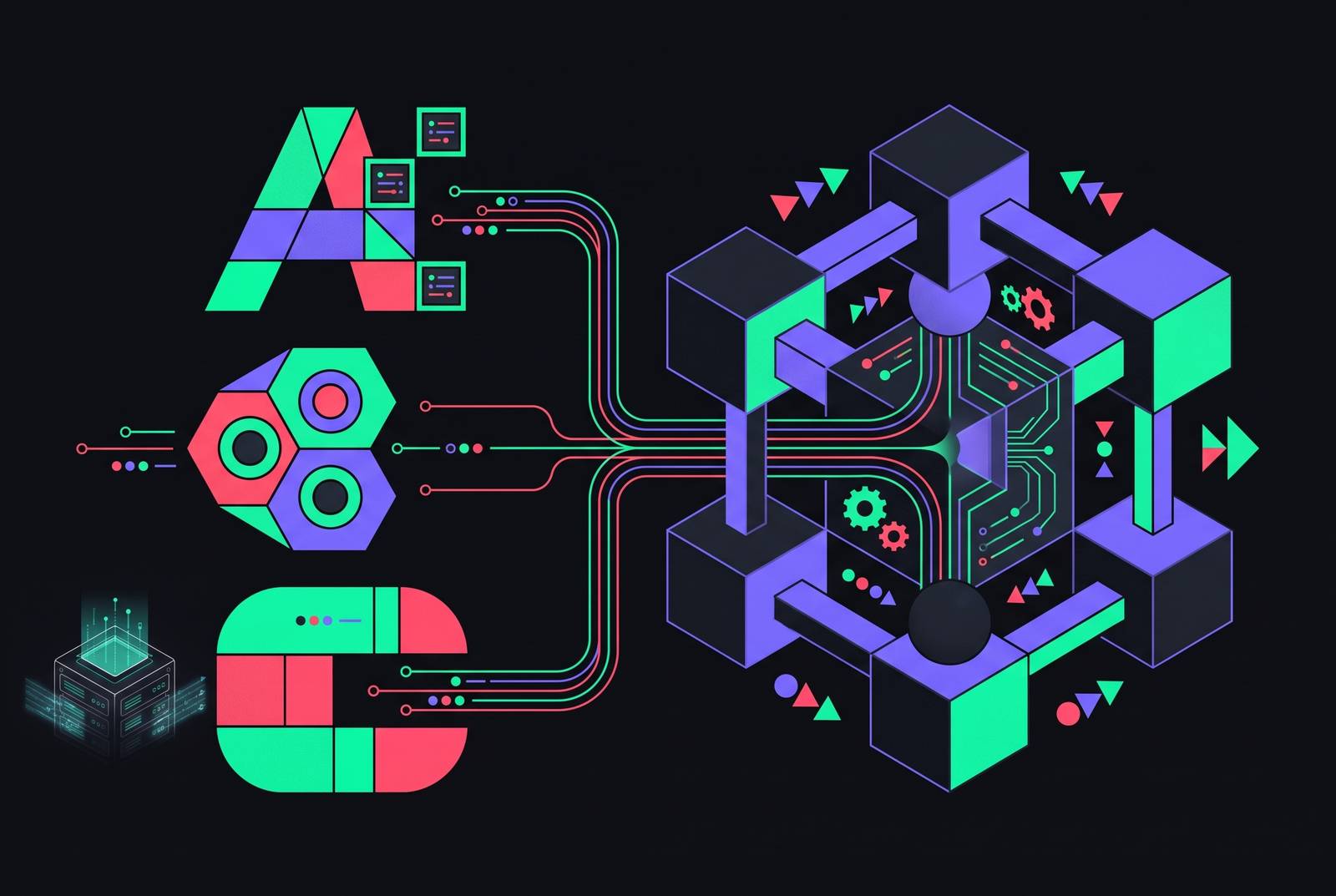
Picture this: a developer asks an AI agent to pull a customer record through an MCP-connected tool. That query should run at the developer's own access level, using the developer's own permissions, not some admin-level credential someone configured on the server months earlier. That single distinction is why picking an MCP client is now a governance decision, not a tooling decision. The Model Context Protocol puts the model itself in the seat of the consumer, not code a developer wrote line by line, and that swap breaks the assumptions the old integration security model was built on.
Classic API integration kept things simple. A developer wrote the call, a fixed service account carried the credential, and the audit log named the calling service. Authority stayed put and stayed predictable. MCP throws that out. The model decides at runtime which tool to call and what data to hand it, so authority has to travel with the human user who kicked off the request, not with some service account sitting on the server.
The protocol's architecture makes the shift explicit. In classic integration, the security boundary is a service account with a fixed scope. In MCP, the system needs on-behalf-of authorization, so when someone asks "who made this request," the answer names a real employee, and that employee's permissions have to apply all the way down to the agent acting on their behalf. The model, not a developer, now picks which tool runs and when. That freedom is where the power comes from, and it's also where the risk comes from. So the old checklist, does it support OAuth, does it log calls, still matters, but it no longer covers the job. Every selection criterion that actually counts for an enterprise, the auth model, the permission controls, the audit trail, is really a question about how a client handles agent identity and tool access once usage scales past a handful of pilot users. That's a governance question before it's a feature question.
Enterprise responsibilities the MCP specification leaves unresolved
The protocol grew up fast in 2026, and it shifted more responsibility onto the people building and deploying clients at the same time. You need a governance-capable client more now, not less, because the spec raised the floor but didn't finish the job.
The July 28, 2026 revision brought a stateless protocol core, support for multi-round-trip requests, header-based routing, and tighter authorization rules. On the authentication side, Enterprise-Managed Authorization stabilized in June 2026, and it's a real milestone. EMA lets an organization's own identity provider, Okta or Microsoft Entra ID, decide which MCP client can reach which MCP server, and on behalf of which user. You can call the technical plumbing behind it ID-JAG, short for Identity Assertion JWT Authorization Grant. Okta was the first identity provider to support it, and Claude, Claude Code, Cowork, and Visual Studio Code were among the first clients to build it in.
That's real progress, but the spec draws a line around what it will and won't guarantee. The stateless core hands tracking identifiers and state objects to the client itself, which opens the door to workflow hijacking, one agent reaching into another agent's data, or unauthorized actions crossing between tenants, depending entirely on how carefully the client manages that state. The new MCP-specific HTTP headers, named things like Mcp-Method and Mcp-Name, create a leak risk if a developer accidentally routes an API key, a token, or someone's personal data into a header, since headers are visible to every load balancer, proxy, and logging system sitting along the path. MCP Apps, now a first-class extension, bring the ordinary risks of a web browser along with them, stored cross-site scripting included. Akamai summed up the shift: security decisions that used to be enforced by the protocol itself are increasingly left to MCP server developers and platform operators to handle on their own.
Agent identity has its own gap too. EMA governs which client can reach which server for a given user, but it doesn't, by itself, establish the identity of an autonomous agent running with no human present. The MCP OAuth Client Credentials extension covers unattended client authentication, but a full standard for agent identity and delegation is still being worked out. On top of that, MCP still has no built-in way to exchange Role-Based Access Control permissions when a session starts, so enforcing or even verifying the access boundary between two tasks or two services is hard to do from the protocol alone.
The honest read is that the floor rose and the ceiling became implementation-dependent. The spec handles more than it used to, but what's left over now falls on whichever client and gateway an enterprise picks. That raises the real question: among the clients available today, which ones actually carry that load?
The attack surface every MCP client selection must account for
MCP has turned into one of the fastest-weaponized attack surfaces in agentic AI, and none of this is theoretical. These attacks are documented, demonstrated, and already happening.
Five vectors recur across these incidents, and any client or gateway built for enterprise use has to answer for all five. Tool poisoning plants malicious instructions inside tool metadata and hijacks the model's decisions before a user does anything at all, and it works because nothing validates tool definitions before they land in the model's context. Token passthrough forwards an upstream token straight to a downstream tool call instead of running it through OAuth 2.0 token exchange under RFC 8693, so a credential meant for one system can reach a system it was never issued for. Session and state hijacking comes from the predictable tracking identifiers the stateless model hands to the client, and it opens three doors: hijacking an active workflow, reaching into another agent's data, or triggering actions across tenant boundaries that were never authorized. Header-based data leakage happens when sensitive inputs, API keys, tokens, personal data, get mapped into those new MCP-specific headers, which are visible to every load balancer, proxy, and log along the route.
One incident makes the risk concrete. Wiz Research disclosed two flaws in the Amazon Q Developer extension, affecting VS Code, JetBrains, Eclipse, and Visual Studio. A malicious repository could trigger arbitrary code execution and steal cloud credentials through a crafted workspace MCP configuration file. The MCP server processes that got spawned inherited the full developer environment, which handed an attacker immediate access to cloud infrastructure. The NSA's May 2026 guidance backs this up from the supply-chain side: public labs and security researchers have released vulnerable MCP server implementations, confirming that the risk is exploitable. The threats dominating 2026 cluster around tool poisoning, rogue or unauthenticated MCP servers, permissions scoped far wider than needed, and tool lifecycles nobody is managing.
If a client can't log tool calls, scope credentials tightly, or validate tool definitions before they enter the model's context, it is leaving a door open that attackers already know how to walk through. That reality sets the terms for what the comparison ahead needs to measure.
The four criteria that separate governance-capable MCP clients from the rest
Four questions decide whether an MCP client can hold up in an enterprise setting, and the first is about agent identity and authentication. A client needs OAuth 2.1 with proper token exchange under RFC 8693, not token passthrough, and it needs to plug into enterprise single sign-on, SAML, SCIM, Entra ID, Okta, so that every tool call traces back to a real user identity rather than a shared credential. It should support EMA, so the organization's own identity provider decides which client reaches which server on whose behalf, and it needs a credible answer for unattended, workload-level identity when an agent runs with no human at the keyboard.
Permission controls and least-privilege access matter next. A central registry of approved MCP servers keeps unapproved servers unreachable through any governed path, and per-tool consent needs to be visible to the people granting it and bounded by time, so it's never granted once and forgotten.
Auditability requires every tool invocation to carry a log entry with user identity, the tool name, the arguments passed, and the result returned. Those logs need to resist tampering and export cleanly to whatever SIEM or OTLP backend the security team already runs, and the organization needs to be able to produce an attributable record of agent activity on demand for a regulator.
Operational scale requires that a client forces every developer to configure their own credentials or else you get credential sprawl across the organization, so the better path runs everything through a centralized control plane instead. Access needs to be revocable for one team or one user without touching every other endpoint in the system, and the deployment model needs to work inside a VPC, on-premises, or in an air-gapped environment, depending on what the organization requires. Put together, these four criteria describe a minimum viable production posture: OAuth 2.1 on every remote endpoint, every tool invocation logged with a real user identity attached, tokens stored centrally rather than scattered across client configuration files, access scoped through identity provider groups, and sensitive operations gated behind explicit approval.
Runlayer is built around all four of these criteria as one platform, rather than as separate tools stitched together after the fact, and that architectural choice is what matters most for an enterprise trying to scale agent adoption without scaling its governance debt at the same pace. On identity, you get OAuth and credential handling built into the platform instead of left to client-side configuration, so you remove the credential sprawl that comes from every developer managing their own keys, and identity gets checked at the depth of each individual tool call, not only once at connection time. On permissions, policy enforcement runs at that same tool-call depth across every MCP server and agent in use, not just at the edge of a gateway, and access to a large marketplace of MCP servers flows through one governed path, so a server that hasn't been approved simply never appears as an option to reach. On auditability, the platform keeps tamper-proof logs across every agent action and runs real-time detection for the attack patterns already named, tool poisoning, prompt injection, intent drift, and exfiltration, producing an audit trail that holds up under regulatory review rather than one built only for day-to-day monitoring. The underlying argument is architectural: a stack built from a separate agent builder, a separate gateway, and a separate security tool means three different policy languages, three separate audit streams, and three integration surfaces to keep patched and working together. Covering enablement, control, and security in a single platform is what separates governance built in from the start from governance bolted onto a system that was never designed to carry it.
How individual MCP clients (Claude Code, Cursor, Gemini CLI, Kiro, and OpenAI Codex CLI) compare on governance criteria
Each of these clients was built first to help a developer move faster, and each now carries some piece of the governance load the protocol leaves to implementers. None of them covers all four criteria at full organizational scale, so a gateway or control plane layered underneath or alongside them has become part of most enterprise deployments, not an optional extra.
Claude Code has the clearest head start on identity. What EMA doesn't resolve for any client, Claude Code included, is workload identity for an agent running unattended with no human in the loop. That gap sits with the broader ecosystem: the MCP OAuth Client Credentials extension addresses it only partially, and no single client's design solves it.
Cursor, built around an IDE-centered workflow, carries the same strengths and the same open questions as most MCP clients tuned for individual developer productivity. Its value is speed inside the editor, where tool calls, context retrieval, and code generation happen in one continuous loop.
Both are built to put an agent directly into a developer's hands with minimal friction, which is the right design goal for adoption and productivity. Neither was built from the ground up to produce tamper-proof, exportable logs that map every tool call back to a real user identity for a compliance team's review.
The pattern across all five clients is consistent. Each solves part of the governance load, usually the part closest to the developer experience, authentication at the point of login, or tool invocation within a single session. That's the role a platform like Runlayer is built to fill: not replacing any of these clients, but giving an organization one place where identity, permissions, and audit trails hold consistent no matter which client a given developer or team happens to be using.